


One Big Thing: Independent Audit Released of UC Davis Equestrian Team Financial Records
Nearly two weeks after UC Davis’ promised deadline, the university released its audit regarding the elimination of the NCAA Division I Women’s Equestrian program. While the report’s release is appreciated, it is important to understand what it does — and does not — address.
The following is from the statement released by UC Davis on July 13, 2026:
The University of California, Davis’ Audit and Management Advisory Services (AMAS) today released its independent audit of the financial records related to the NCAA Division I Women’s Equestrian program, which transitioned to a club sport on July 1, 2026.
The audit did not find that Athletic Director Rocko DeLuca, members of the Athletics leadership team and other university officials acted outside of good faith or failed to comply with university protocols and accounting best practices during the evaluation process. AMAS also found no deviation from acceptable practice in how Athletics leadership and the university officials carried out their responsibilities.
AMAS found that several outside parties, including consulting firms and concerned external stakeholders, relied on NCAA reporting to understand the basis for a decision to transition Equestrian from varsity to a club sport, and this led to assumptions that the university erroneously included the value of in-kind donations in estimates of potential cost savings. However, AMAS found that the decision was based on budgeting documents separately prepared for the UC Davis budget office, which did not include the value of in-kind donations.
AMAS concluded that UC Davis budget documents “appropriately” excluded the in-kind donations, which resulted in a difference of $690,000 between the NCAA-reported numbers and UC Davis’ internal budgeting in fiscal 2025.
AMAS recommended that Athletics strengthen its financial reporting practices by adopting standardized methods. In recent years, Athletics has prepared and reviewed financial outcomes using processes that were not based on accepted reporting workbooks or other formal, documented procedures. AMAS recommended that Athletics adopt standard practices, such as those that the NCAA uses, to bring its reporting into alignment with industry-recognized standards.
UC Davis leaders accept the audit’s recommendations to strengthen Athletics’ financial reporting processes and will implement appropriate corrective actions.
Far from providing the unequivocal vindication described in Director DeLuca’s accompanying statement, the audit identifies clear deficiencies with the Athletic Department’s financial reporting, fundraising oversight, and consultant review processes — the very systems relied upon to justify eliminating the program. The audit and corresponding statements also leave many of the questions most important to stakeholders unanswered.
First, this was a compliance audit, not the independent forensic investigation that student-athletes, families, donors, alumni, and legislators have requested since they were blindsided by the university’s January 9 decision. The compliance audit’s scope is significantly narrower than expected.
The audit did not examine Title IX concerns, false and misleading recruiting practices, or the assumptions underlying projected STUNT costs. It reviewed only two external communications despite months of internal e-mails and public statements alluding to predetermination regarding the program’s elimination. Even its review of fundraising was limited, with auditors expressly acknowledging that a comprehensive assessment fell outside the scope of their work and would need to be addressed in a future audit.
The audit also identified several significant process failures within UC Davis Athletics, including inadequate documentation supporting NCAA financial reporting, insufficient oversight of fundraising activities, and consultant analyses that relied upon financial information not intended for internal budgeting decisions. The report recommends improved documentation, stronger validation procedures, clearer oversight, and more rigorous review of consultant assumptions and methodologies before they are relied upon in decision-making.
These are not minor administrative recommendations. They are acknowledgements that financial and oversight processes relied upon during one of the most consequential athletic decisions in recent university history were insufficient and require corrective action.
Perhaps most notably, the audit acknowledges that Collegiate Consulting relied on NCAA financial data intended for external reporting rather than internal budgeting decisions. The audit concludes that the consultant’s assumptions and methodology should have been validated against the university’s own accounting records before being used to support a major strategic decision. This is significant because Collegiate Consulting’s analysis portrayed equestrian as costing substantially more than comparable calculations now suggest, yet that analysis was repeatedly cited to justify eliminating the team. Questions about the consultant’s analysis have been at the center of stakeholders’ calls for a broader independent review. In April, stakeholders of the team released the initial findings of an independent review conducted by OSKR, an economic and accounting firm, which challenged the financial assumptions used to justify the program’s elimination.
If that report served as independent support for eliminating a Division I program, stakeholders deserve to know why its assumptions and underlying financial inputs were never validated before the decision was made.
The university now recommends new procedures to ensure consultant assumptions, methods, and financial inputs are carefully reviewed before being relied upon in the future. This is particularly significant because Collegiate Consulting’s analysis portrayed equestrian as costing roughly twice as much as comparable calculations now suggest. The university has effectively acknowledged that the consultant’s report relied on inaccurate financial inputs, yet that same report was repeatedly cited in support of eliminating the team. Moreover, the financial figures used by the consultant were also reflected in Athletics’ own analyses and public representations regarding program cost and the same budgets and financial data that Collegiate Consulting relied upon in their report justifying the program’s elimination.
The report further asks stakeholders to accept its conclusions without releasing the detailed financial analyses, calculations, schedules, and supporting documentation necessary for independent review. In effect, the university is again asking the public to trust an opaque process that the audit itself says lacked sufficient documentation, review, and oversight. Transparency requires more than assurances — it requires factual information.
Finally, the audit does not address one of the central concerns raised throughout this process: not simply whether certain budget figures could be reconciled, but how those figures were presented to justify eliminating the program. It does not evaluate repeated public claims that equestrian was among the university’s most expensive sports or had the highest cost per student-athlete, nor does it examine whether those comparisons accurately reflected the underlying financial data and provided appropriate context. Those concerns are even more significant now that the university has acknowledged errors in the financial information relied upon by its consultant and reflected in NCAA reporting data. Those claims played a major role in shaping public opinion and decision, yet they remain largely unfounded and unexamined.
The university has consistently maintained that this was a financial decision. Yet, supporters offered to explore funding solutions, including an endowment or bridge funding that could sustain the program for two to four years and provide current student-athletes and recruits an opportunity to complete their collegiate careers or transition in an orderly manner. Despite those efforts, the university declined to pursue those discussions.
Ultimately, the audit answers far less than the university suggests. While it identifies problems and deficiencies in financial reporting, fundraising oversight, and consultant review processes, including the use of inaccurate financial information in analyses that helped support the program’s elimination, it leaves many of the questions that prompted calls for independent scrutiny unresolved. Rather than putting this matter to rest, the report reinforces why an independent external investigation remains necessary. The university must also release the financial analyses, calculations, and supporting documentation used to justify this decision; not another statement and message that took weeks to craft by a PR department.
The university may consider this matter resolved. For those still seeking the evidence behind the decision, it remains anything but.
About Reinstate UC Davis Equestrian
Reinstate UC Davis Equestrian is a coalition of past and present team members, parents, and community supporters advocating for the reinstatement of the UC Davis D1 NCEA Equestrian Team. The coalition seeks to preserve valuable opportunities for current and future student-athletes and uphold UC Davis’s longstanding equestrian legacy. The team has long advanced gender equity in sports, supported academic excellence, and fostered meaningful engagement with animal welfare and environmental stewardship — core values aligned with UC Davis’s mission and leadership in veterinary and agricultural sciences. For more information, visit keepdavisriding.com, and follow our Instagram @savedaviseq
Major International Events This Weekend
FEI Eventing Nations Cup Avenches CCIO4*-NC-S (SUI): [Website] [Schedule] [Entries/Ride Times/Scoring] [CrossCountry App XC Maps] [Live Stream] [EN’s Coverage]
The Event at Rebecca Farm CCI4*-L (USA): [Website] [Schedule] [Entries/Ride Times] [Scoring] [CrossCountry App XC Maps] [ClipMyHorse.TV Live Stream] [YouTube Live Stream] [Volunteer]
US Events This Weekend
Kentucky Summer HT (KY): [Website] [Entries/Ride Times] [Scoring] [Volunteer] [CrossCountry App XC Maps]
Horse Park of New Jersey HT II (NJ): [Website] [Entries/Ride Times] [Scoring] [Volunteer]
Silverwood Farm HT (WI): [Website] [Entries/Ride Times] [Scoring]
Course Brook Farm Summer HT (MA): [Website] [Entries/Ride Times] [Scoring] [Volunteer]
Full Gallop Farm July HT (SC): [Website] [Entries/Ride Times] [Scoring] [Volunteer] [CrossCountry App XC Maps]
Applewood Farm YEH, OEH & Mini Event (NJ): [Website] [Entries/Ride Times] [Scoring]
Other Links and Reading
Chewy Pick of the Day
This post contains affiliate links, and Eventing Nation earns a commission on qualifying purchases as part of Chewy's ambassador program.
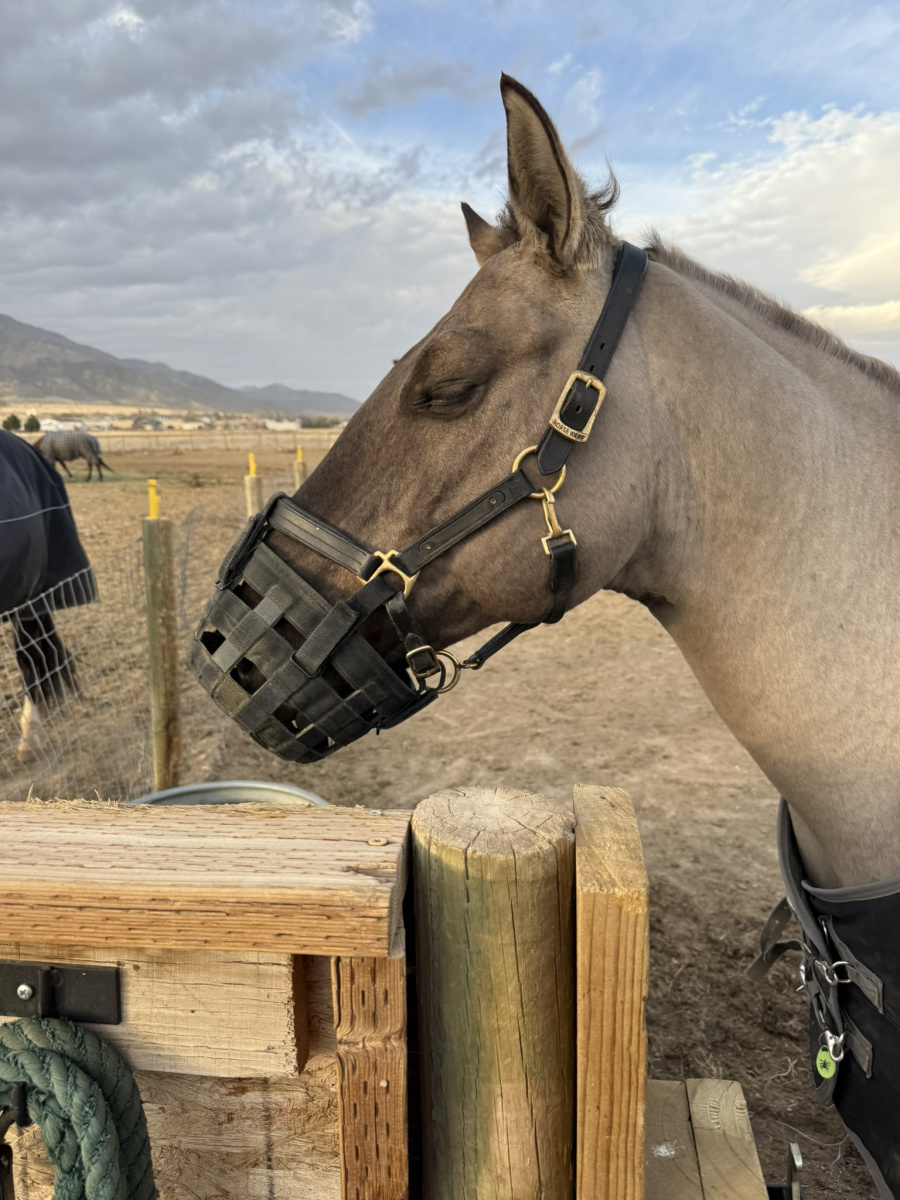
My most recent horse was an angel pony, the sweetest guy around, a perfect gentleman with the kiddos… but when it came to pasture time for one overweight Quarter Horse, it was a daily battle of life (with horse obesity) and death (from horse diabetes). Over the course of 14 months, I went through 11 different grazing muzzles — because despite the slow-feeder nets on each pasture’s large square bales, Spider was determined to rip holes, break halters, corrupt and petition pasture-mates, and generally create all possible opportunities for chaos to achieve his ultimate end goal of eating himself to death.
In his final days within my barn program (before being sold to a new owner who crossed her heart that he’d live on a dry lot), the Tough1 Deluxe Easy Breathe V-Nose Horse Grazing Muzzle was the only one that remained on his head, unbroken, still allowed him to eat, and didn’t create rubs around his poll or throatlatch. It earned bonus points for being incredibly affordable, and despite his previous record of bending, snapping, tearing (yes, the $100 model we know and love ended up torn in half on the ground in his shed), or removing various muzzles, it stayed in place and did its job — all you really need from your chosen “torture device” (Spider’s words, not mine) to keep your horse healthy.
For tax: Spider accepting his fate with his first of many torture devices to come.
Training Tip of the Day
Blake Dudzik explains how your hamstrings might be ruining your seat… and your horses movement:
Go Eventing
At just 19, Rupert Hyde continues to rise to every challenge: