


As someone with Chronic Exertional Compartment Syndrome, I’ve been a proponent and avid user of Freejump’s Soft’Up Pro Stirrups for almost a decade now. They are, quite literally, the only stirrups I’ve found where I can actually have jump-length stirrups and not have my legs feel like they’re on fire within five minutes. And because of who I am as a person (i.e. very nosy, curious, and borderline absurd), when I first started using the Freejump stirrups, I did a lot of research into the brand, their research, and the science behind the design. I’ve been impressed with Freejump as a company ever since.
So when their new Voronoï helmet hit the market, I was naturally very intrigued by it. It’s certainly eye-catching, with its design centered around temporal impact protection, and it looks quite different from anything else on the market. As an eventer (who, uh, isn’t getting any younger), I care a lot about safety, and any product with new and different technology or design features always piques my interest. I will admit though, I had a lot of questions, as I’m sure you do as well. Don’t worry, we’ll get to those.
First Impressions: The Design and Features
Right out of the box, the Voronoï looks and feels different from any other helmet I’ve had. The temple protection area that extends from the front and back of the helmet, around the ear, is unique to the Freejump Voronoï. This part of the helmet is removable, for those who would like to take it on or off, but IMO it’s one of the selling-point safety features of the helmet. It’s designed to protect the most fragile part of your skull from impact, important because some studies have shown that injuries to the temple area are responsible for 80% of serious brain lesions, yet most riding helmets offer minimal protection to that area.
Despite having more surface area to it, the Voronoï doesn’t feel heavy or bulky. At the same time, the materials (these helmets are entirely made in Europe from European materials) feel sturdy and strong. The finish and details are clearly higher-end. I have the Carbon model, and the interwoven fibers of the carbon shell are designed for impact resistance. It also has in-molding technology, which adds an extra protective barrier between the outer carbon shell and the inner low-density EPS foam shell.
One other thing that I’ve gotten to be a big stickler about is brim safety. Yeah, you read that right. Having a helmet brim that doesn’t pop off or flex can be dangerous for impacts particularly on turf (if you like your face how it is, anyway) or modern surfaces like GGT, so I will not, under any circumstances, wear a helmet that has a permanently fixed brim. The Voronoï ticks two boxes here: not only is the brim VERY flexible, it can also pop off.
Of course the Voronoï helmet is certified to multiple safety standards, including the latest CE EN1384.2023 European standard and the STM SEIN F1165-23 American standard.
Ah, but how’s the ventilation? Not only do I live in Florida, I also sweat more profusely than Tilly at a rider’s party, so I can assure you that I have tested this. The Voronoï helmet has a large vent in both the front and the back, with the design having been inspired by the helmet’s namesake, the Voronoï pattern, commonly seen in dragonfly wings. (I am a sucker for small but cool details like this, including the little dragonflies in the Freejump logo). That particular geometric pattern was chosen to help optimize airflow and provide better thermal regulation while also maximizing the strength of the large external vents. These two large vents feed to 20 total vents that help push airflow around the entire shell of the helmet.
Last but not least, the liner is made from Italian fabrics (because of course it is) to maximize comfort, durability, and allow for customized fit. Have no fear fellow Floridians, it’s also fully removable and washable.
But What About That Temporal Protection Piece?
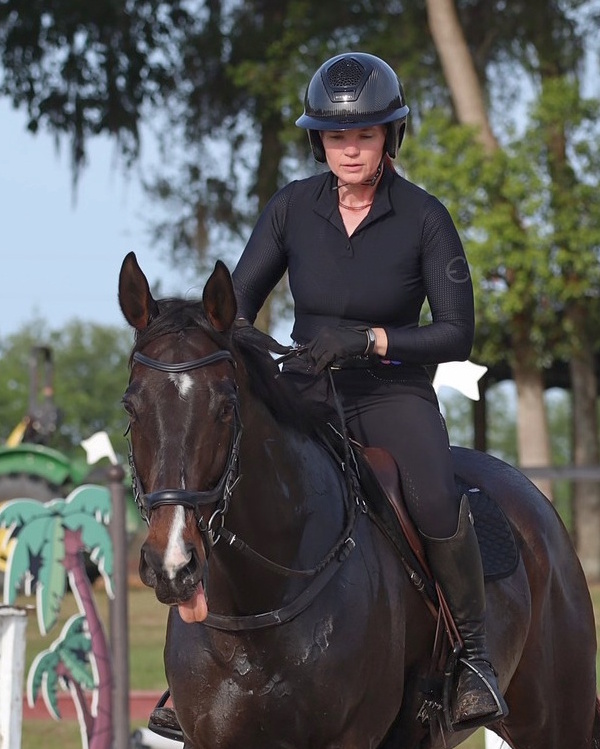
While I love the idea of added protection around the temple, I wasn’t sure how I’d feel about actually wearing the helmet itself. Would it feel bulky? Look ridiculous? Would that piece on the sides impact my peripheral vision?
I was actually kind of surprised that the answer to all those questions is no. I was willing to make some concessions for the added safety, but none were required. Once the helmet is on I don’t see the temporal protection pieces at all, nor do they touch my skin. I completely forget they’re there unless for some reason I go to scratch my ear. The design isn’t intrusive at all.
It does have a slightly different look to it, for sure, but I don’t find it offensive or particularly bulky. If anything, it reminds me more of helmets you see in other sports, particularly ones with head injury rates similar to ours. Much like other new or different items of equipment – air vests being a good example – once you get used to seeing it, it doesn’t look odd or different anymore.
It did take me a few days to figure out the best way to put the helmet on over my ears. The rep advised a back-to-front method but I figured out that for me front-to-back seems to work best. Now it’s second nature.
Fit & Feel

Helmet fit is obviously the most important factor, and this one is a winner for me. Like a few other helmets on the market, the Voronoï is not super oval nor is it super round, but the liner provides options for helping customize the fit. I do wear one size smaller in the Voronoï than I do in my other helmets, but being able to change out the liners also offers some dynamic fit options as well (particularly if you want to wear it at home with your hair down vs at shows with your hair up – easily doable by changing the liner).
One piece of advice I was given that I do feel is important: if you’re in between shell sizes (like for me, I wear a 56 which could be either a Small shell or a Medium shell) you should take your face shape into consideration. I have a rounder face, so choosing a Medium shell ensures that the temple protection doesn’t sit too close to my face. Someone with a narrow face would probably be better off choosing the Small.
Another thing I’ve noticed is that this helmet feels very stable on my head – like more stable than your average helmet for sure, aided by the temple protection piece. This thing isn’t slipping down or sliding around. It also helps the chin strap sit and stay exactly where it should, without that slight looseness or shifting you sometimes get with other helmets.
The Accessories Really Sell It

The Voronoï’s in-helmet comms system adds the ability to safely take calls or even receive coaching via phone call.
Listen, if there’s one thing the French are especially good at, it’s accessorizing, and turns out helmets are no different. From winter ear pads to a whole-ass (can I say ass in a helmet review?) communication system, every part of this helmet feels intentional and specific.
Yes, I said communication system. There’s an accessory called the Cardo that clips quickly and securely (trust me, I tested it) into the ear of the helmet, something that I think is exceptionally cool for many reasons. First, you can take hands-free phone calls. For busy professionals, or amateurs that maybe sometimes take a meeting while on their horse (not that I would know anything about that), this is REALLY cool. No more trying to shove your phone into your helmet harness.
Even more interestingly, this comm system can be used for lessons or in warmup between a coach and rider. No more having to yell instructions to a rider across a warmup or on a windy day, and no more straining to hear what your coach is saying. Clip it in, connect, and you’re good to go. When you’re done or ready to go in the show ring, you can unclip it quickly with one hand. There’s no additional pieces that you have to clip to your belt and no wires that you have to watch out for.
But I’m An Eventer – Can I Make It Fun?
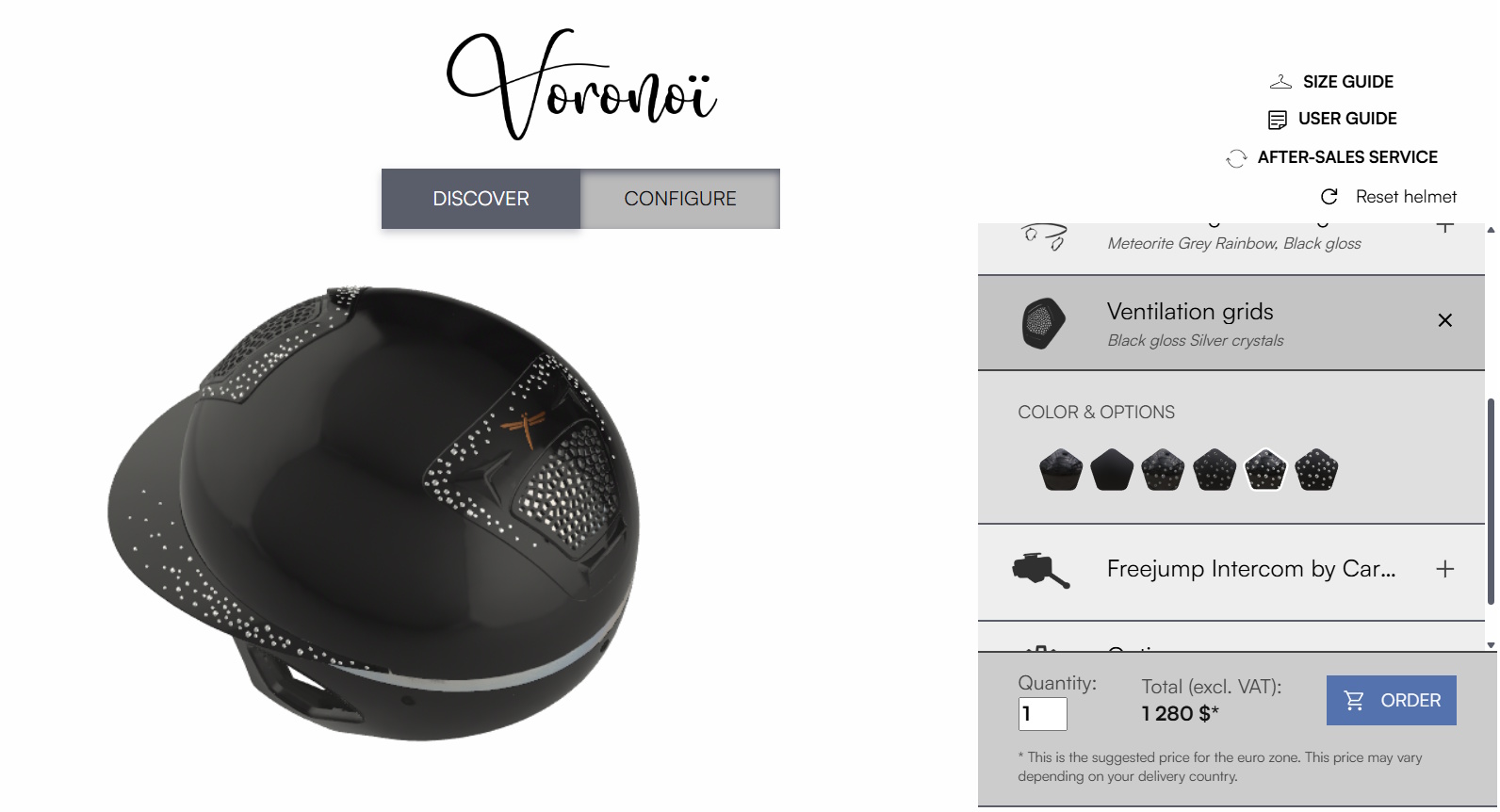
Have no fear, not only can you customize the Voronoï, they also have an online configurator (the truest way to a girl’s heart). This was very dangerous information for me to have, because now I desperately need a black glossy Voronoï with silver sparkles. But whether you want matte or gloss, different colors, sparkles, or even your country’s flag – you name it, you can customize it.
As far as sizing, it comes in three different shell sizes – S,M,L – and liner sizes from 52ccm to 62cm.
It’s worth noting that the Voronoï also comes in a cross country model, which I haven’t seen in person yet but it looks very interesting online. It’s got all the same safety features but designed with cross country in mind.
Final Thoughts: Worth the Hype?
For me, yes. It feels like a normal helmet to wear, but it’s more secure, more stable, and more thoughtfully designed. I haven’t tested it in a fall (and just in case any of my horses are reading this: I WOULD PREFER TO KEEP IT THAT WAY), but based on how it fits and functions, it does give me an elevated sense of protection.
I suspect that this design with added temporal protection will likely pick up traction, particularly among eventers and showjumpers.
Much like my long-beloved Freejump stirrups, I think the Voronoï helmet has earned its place in my kit.
You’ll be able to meet the team at Freejump and see the Voronoï helmet for yourself at Defender Kentucky — make sure to stop by!
How EN Does Product Reviews:
We believe that product reviews are the most useful when they’re honest. We will always let you know if we’ve been compensated in some way for writing a product review; in all review cases, we reserve the right to write with honesty on our experience with a product, with no editing authority given to the sponsoring party or brand. This review of Freejump’s Voronoï helmet was compensated as a part of an advertising package. This review reflects our writer’s full experience using this product.