

We spend a lot of time highlighting the riders and the programs at the top of the sport, but we also should be talking more about how to grow the sport’s base. It’s no secret that membership and competition entry numbers aren’t exactly exploding. Many programs around the country (and the world) have found ways to make headway into the broader world by attracting budding riders to well-run riding school programs. This year on EN, we’ll be paying a virtual visit to several of these programs to ask them what drives them, how they’ve set their business up and what, perhaps, we can all take away when we think about growing the sport from the bottom up. Look for new installments of this series coming your way regularly.
To read more from our Access Eventing series, click here.
Much has been said of the tribulations that upper-level eventers must withstand to achieve their professional and competitive goals. Even the most successful athletes operate on razor thin budgets and a need to have ongoing sales and consistent students to keep the wheels on the bus. For Kansas-based Julie Wolfert, these challenges are compounded by being based far outside of “hubs” like Areas II and III, for example. An average person would rapidly back away from the work needed to be part of that life. Julie has not only built a successful career at the upper levels of the sport but also a successful riding program for dozens of Midwest riders.
Celebrating Horses and People Spirit
When you talk to Julie about how she found eventing and began her riding program, it’s easy to just be amazed that she even found this path. Her parents have never been active riders outside of the occasional pleasure ride. But they still decided to purchase a 40-acre farm outside of Kansas City when Julie was still a child for her mom, Susie, to establish a therapeutic riding program. They named the farm, which started as just open fields and a few sheds, Chaps for “Celebrating Horses and People Spirit”. “My mom just loves taking care of people and she’s so patient and good. That was her calling,” Julie says.
Growing up on a farm with horses meant that Julie was lucky to start riding at an early age. She successfully competed in the local hunter/jumper circuit with Kendall Lacey but had no knowledge of eventing as a sport until she watched the 1996 Atlanta Olympics on television. “I was like, oh my gosh what are they doing! They were galloping horses across the field and jumping big jumps,” she said. “I had no idea that eventing existed and was a sport.” At this point 16-year-old Julie’s riding focus shifted to how to be an eventer.
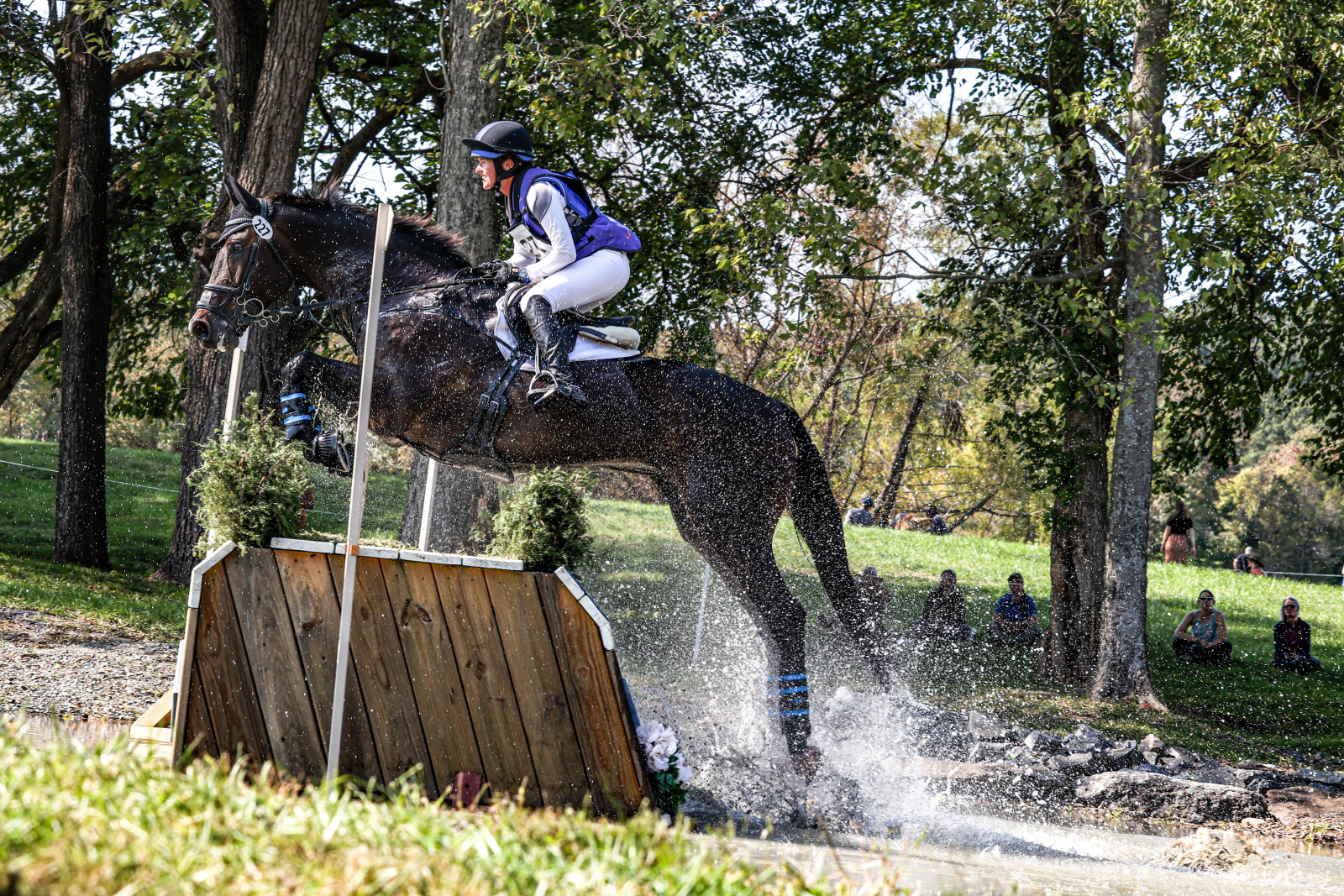
Julie Wolfert and SSH Playboy en route to winning the Morven Park CCI4*-L in 2024. Photo by Sally Spickard.
Julie went from zero knowledge about eventing to happily discovering Heritage Park horse trials just 10 minutes down the road in Olathe. “It was hiding in plain sight,” Julie recalled. She utilized all of Heritage Park’s resources and took to eventing like the proverbial duck to water. Julie was self-taught up to the Preliminary level with success when she found herself competing at the American Eventing Championships in Lamplight, IL. At the Championship Julie was stabled next to Emily Mastervich who she quickly connected with and realized could provide the professional assistance required to keep achieving her goals. “Emily helped me get to the Advanced level. I have always been based in Kansas City so I would commute from KC to Virgina for a few years. I don’t like doing clinics so she’s basically the only eventing trainer I’ve had!”
As Julie explored what it would take to be an eventer, she also began crafting her lesson program at Chaps. She was able to utilize her Mom’s therapeutic riding horses to teach basic walk/trot and lunge line lessons for local students. “I had about three or four lesson horses that I could use. They were so quiet that anyone could learn how to ride on them,” Julie said. As she expanded her knowledge base with working student positions for Emily it eventually came time for her to go off to college. However her attention was always truly stayed with her growing business and she always came back home to keep her program going. “I just knew. I went to college for one year and I was like, this is ridiculous. I want to be a trainer,” she laughed.
Midwest Resourcefulness & Program Management
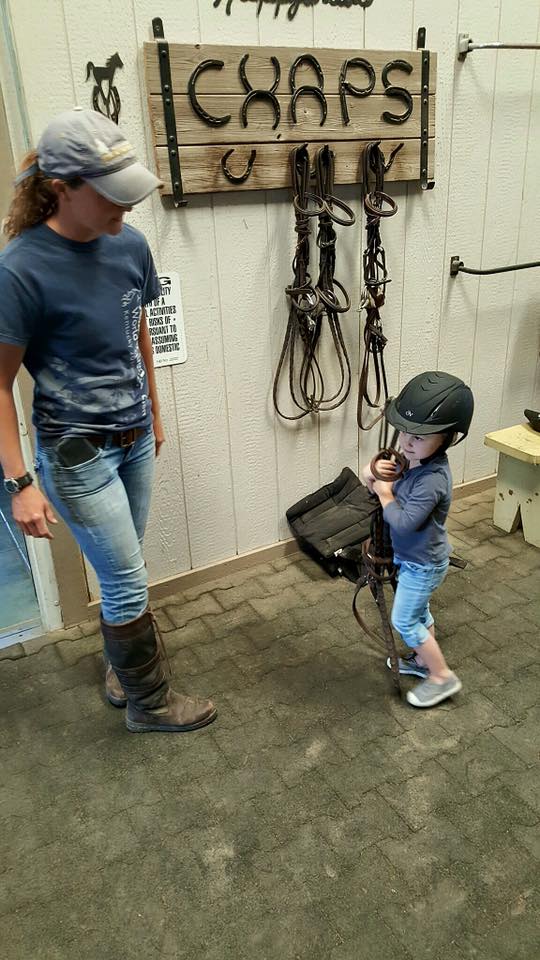
Even the smallest students are welcomed at Chaps Equestrian Center in Bucyrus, KS! Photo courtesy of Julie Wolfert.
Today, Chaps Equestrian Center is fully owned by Julie and has been transformed into a full-service eventing facility. The 40 acres that started as just fields and a few sheds are now compromised of multiple barns totaling 15 stalls for about eleven or twelve horses. Four are Julie’s personal horses with the remaining being clients in training with her. She has large indoor and outdoor arenas and a cross-country schooling field. Julie laughs as she describes her schooling field as “a very Midwest cross country field.” It doesn’t have a water complex but is full of varying levels of jumps that she built or bought over the years including the ditch that she dug and built herself. This resourcefulness extends to how she manages day-to-day operations. “Believe me when I say I do not have any working students. I literally mow the fields and feed the horses. I am the trainer, the groom, I am everything. That’s just how I can keep it afloat and afford everything.”
It is important to note here how Julie has purposefully transitioned her program so that she is able to support her own riding goals while running a farm and manage a training and boarding program. Julie says, “When I was starting to develop the training program, I had a lot of lesson horses that could jump and all that. But then my program shifted where basically everyone hauls onto my farm with their own horse.” Her students range from entry level to the Intermediate International level. “I’m a pretty private facility where if you board with me, you are in training with me,” Julie continues. “I do it all myself so I do not want to have 20 horses on the property because I would run myself into the ground.”
As a working professional rider and trainer with her own facility, it would certainly be tempting for Julie to pack in as many boarders as possible onto her farm to help with overhead expenses, but this thoughtful management of her time and willingness to put sweat equity into her property is what contributes to her success. Though she limits the number of horses boarding at Chaps Equestrian Center and most of her students are haul ins, Julie still spends a significant amount of time teaching pony club and other students just coming into the sport.
“Many people assume that just because I ride at upper-level and have upper-level students that I won’t teach up-down lessons. Whenever I hear that it actually makes me angry. I enjoy my time with our local Pony Clubs and with students that are barely doing 18 inches,” Julie says, “I even have some western dressage riders and it’s been so fun working with them. It is a different take for them training with me and they like the fact that I can help them out even though they’re in western tack.”
Engaged Care
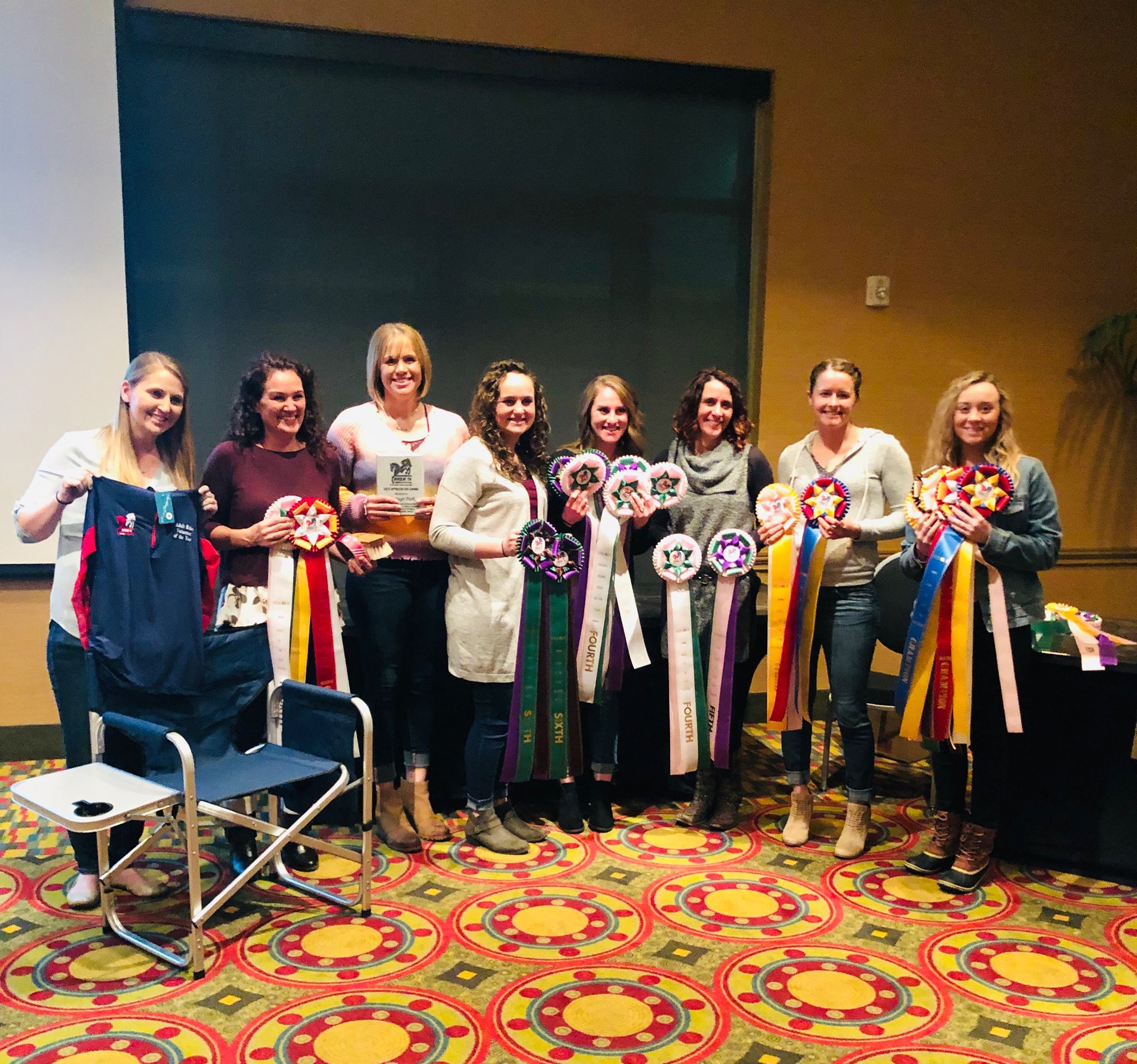
JWE students showing off their winnings at an Awards Banquet.
Since Julie’s training program is mostly decentralized, it would be easy for her to default to just teaching a lesson or coaching at an event and keep it moving to the next student. But she makes sure to involve herself in the education of her students’ horsemanship and care of their horses which is especially important living in a part of the country where everyone is spread out and a student might not have close access to institutional knowledge for sport horse care.
This can range from Julie noticing that a horse is struggling with an exercise and suggesting that the horse might be having a physical issue a veterinarian should address, to show turn out, to designing a conditioning program individualized for each horse so that it can be appropriately fit for its level. This is key in pancake-flat Kansas where sprint work is going to be more effective than your traditional long trot and canter sets. Julie also makes sure that her students know she is a resource when inevitable problems occur. “I get texts all through the day and sometimes night asking for advice when a problem comes up even though I’m not a vet myself,” she says.
Efficiency is important when you have as many balls in the air as Julie and that extends to how she teaches her students. “I enjoy seeing challenges and then trying to figure out different ways to help them understand something. Even if it’s a different way to explain to them how to put their heels down or how to close your lower leg around the horse,” she explained. Many times the fastest way to help a student along is to hop on their horse herself. “I might get on a horse and find that I’m doing stuff that I don’t realize I’m doing. It comes natural to me, but that might not come as naturally to my student.” This extends to cross country schooling if a student is having a problem with an element like a ditch. “I’ve found that students really do like (when I school their horse) because they might be really nervous and then they can see their horse do it. I can change the mood for the day and my student believes that they can immediately go do it,” she says.
Finding the Chaps Equestrian Center Community
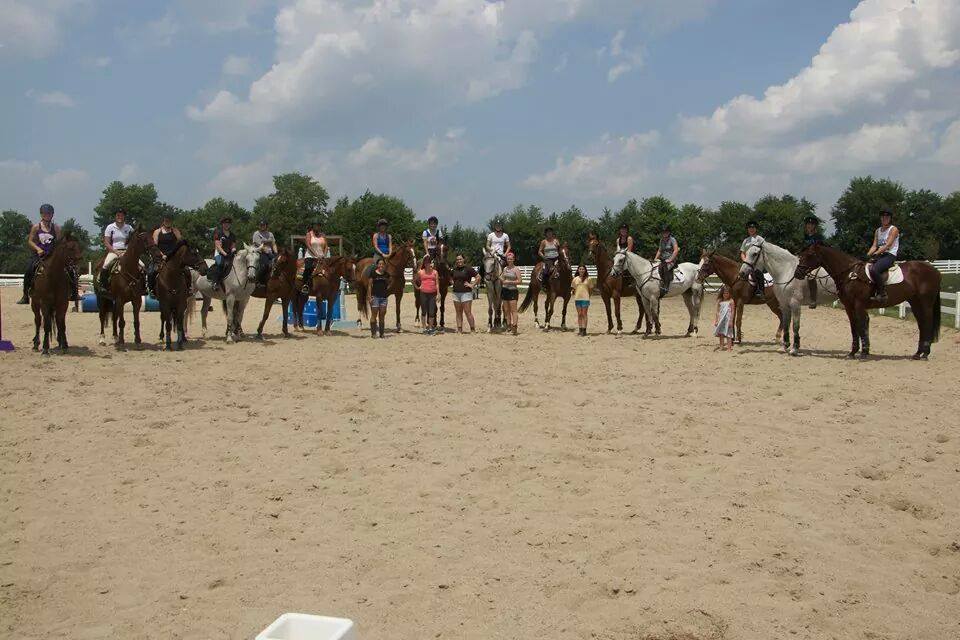
Photo courtesy of Julie Wolfert.
Chaps Equestrian Center is located about 30 minutes south of Kansas City in blink-and-you’ll-miss-it Bucyrus, KS. The farm’s close location to an urban area and Mill Street Pony Club helps to keep Julie consistently busy with eager students. Along with her regular clients, she has also earned a reputation for being a coach who willingly helps people on the fly at a show. “I do a lot of catch training. I’ll get a message a week out from a show from someone saying they’re coming in from Minnesota and their trainer can’t make it,” Julie says. I can help them with the course walk and all that.” She has also worked with some students in a barter system where she can exchange discounted lessons for them feeding her horses while she is away competing. For Julie, it is all about being as flexible as she can be so that people who are dedicated to horses and eventing are able to continue their passion. She easily relates to students who drive two hours and more one way to learn from her. “I just really want the sport to keep thriving in our area and keep going. I will do whatever I can to help.”
This dedication has helped Julie build a 30+ student community made up of people from all around the Midwest. She is active on boards of the Mid America Eventing Association (MIA) and Heritage Park Horse Trials and regularly donates lessons to Pony Clubs that can be used for benefit auctions and trivia nights.
Julie maintains a welcoming ‘come one, come all’ attitude with her program. When she travels to Florida for winter training, she makes sure that her students know that they are welcome to join her even if it’s just for a few days. Also, a student does not have to be in regular training if they’d like to join her down South. “It helps me sleep at night that I’m helping everyone else. I’m just here to help people and I do what I can,” she says. “That’s definitely the Midwest in me.”
“>
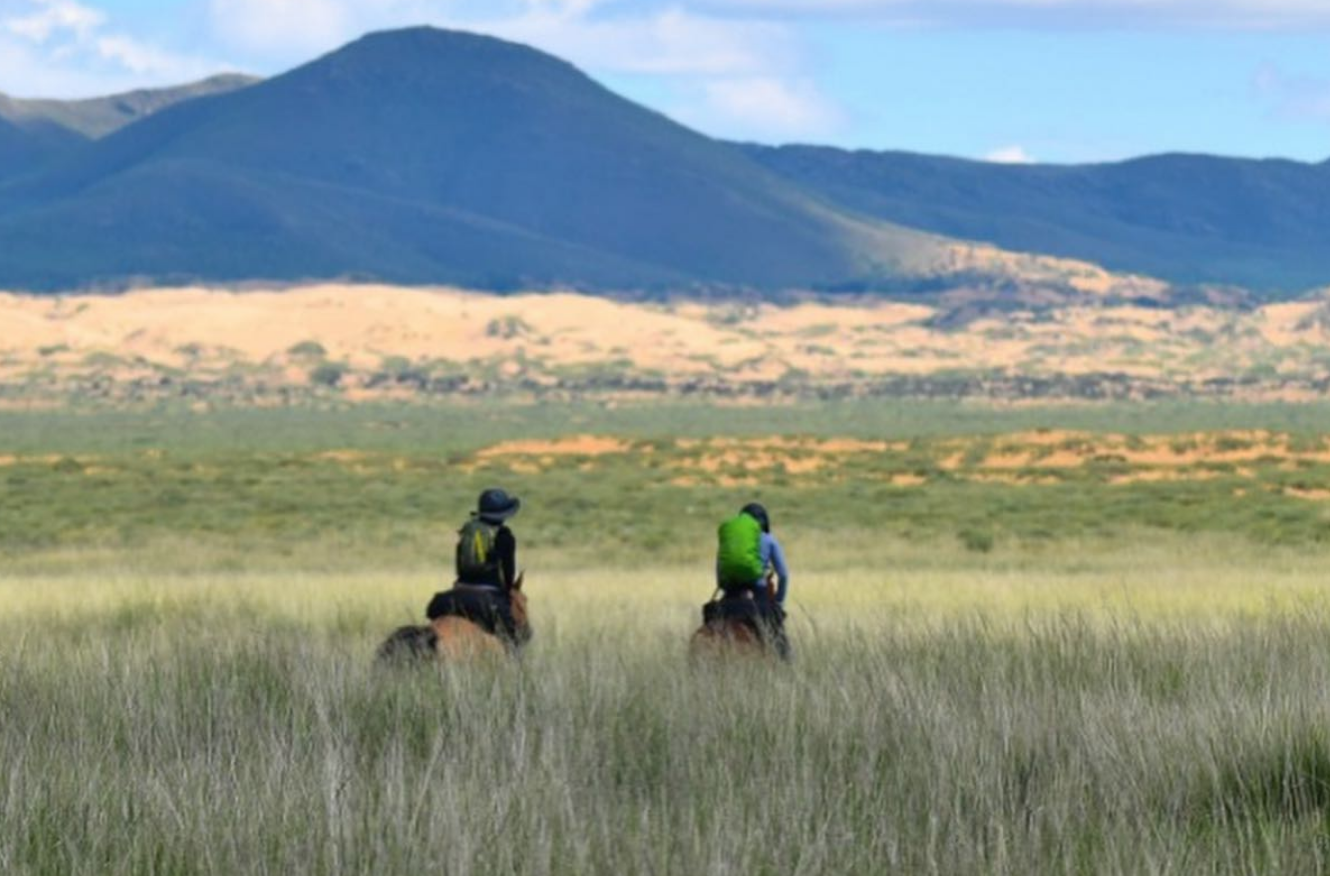
Oh, also, Julie competed in the Mongol Derby in 2022 alongside friend and longtime supporter Renee Senter. Photo by Bayarsaihan Ochiroo.
Though Julie keeps a jovial attitude while discussing her program, she does turn serious when discussing how she manages her students’ goal setting, expectations, and safety. “Being a trainer can be tricky because I’m also pretty close friends with them. I have to be able to turn off ‘friend Julie’ and turn on ‘trainer Julie’ and not worry about hurting someone’s feelings at the end of the day. What matters most is the safety and well-being of the student and I have to forget about how this might affect our relationship”, she says.
Julie has often had to have difficult conversations not just with riders, but also parents, to let them know that their expectations are greater than their current skill set or their child’s skill set. “I always say, this is a dangerous sport. You pay me for my opinion and you need to respect that. I have found people respect me almost more because I gave them my honest opinion and they do appreciate that I am looking out for them. I don’t sugar coat things. If they aren’t ready, I’m not afraid to tell someone that.”
This honesty also extends to a student with a goal such as competing at the American Eventing Championships but is reluctant to put the resources needed to travel out of the area to compete. This is especially important because a student may technically be qualified from results at local events but has not been to a show with a larger atmosphere. “If you’re going to go to AECs, you need to compete out of state and go places you haven’t cross country schooled before. So I have those conversations where I have to tell someone they aren’t ready and everyone respects that. And I appreciate it.”
Julie’s good-humored attitude returns when discussing her community. Most of her students are adult amateurs who can honestly tell her when they show up that they haven’t been able to ride their horse for a couple of weeks. Like most of us, her students rely on their time at her farm as a break from real-life problems and primarily want to have a fun time while learning with their horse. She says, “We’re all a community and we like to randomly do things together. We’re all horse people and we all have that in common.”
Julie Wolfert is an Eventing International CCI 4* rider with several top ten finishes at the level including a CCI4*-L win in October 2024 with SSH Playboy at Morven Park in Leesburg, VA. In 2022, she completed the Mongol Derby in East Asia and in 2025 she was awarded the Amanda Pirie Warrington Grant by the United States Equestrian Team (USET) Foundation. She owns Chaps Equestrian Center, an eventing sport horse training facility in Bucyrus, KS.