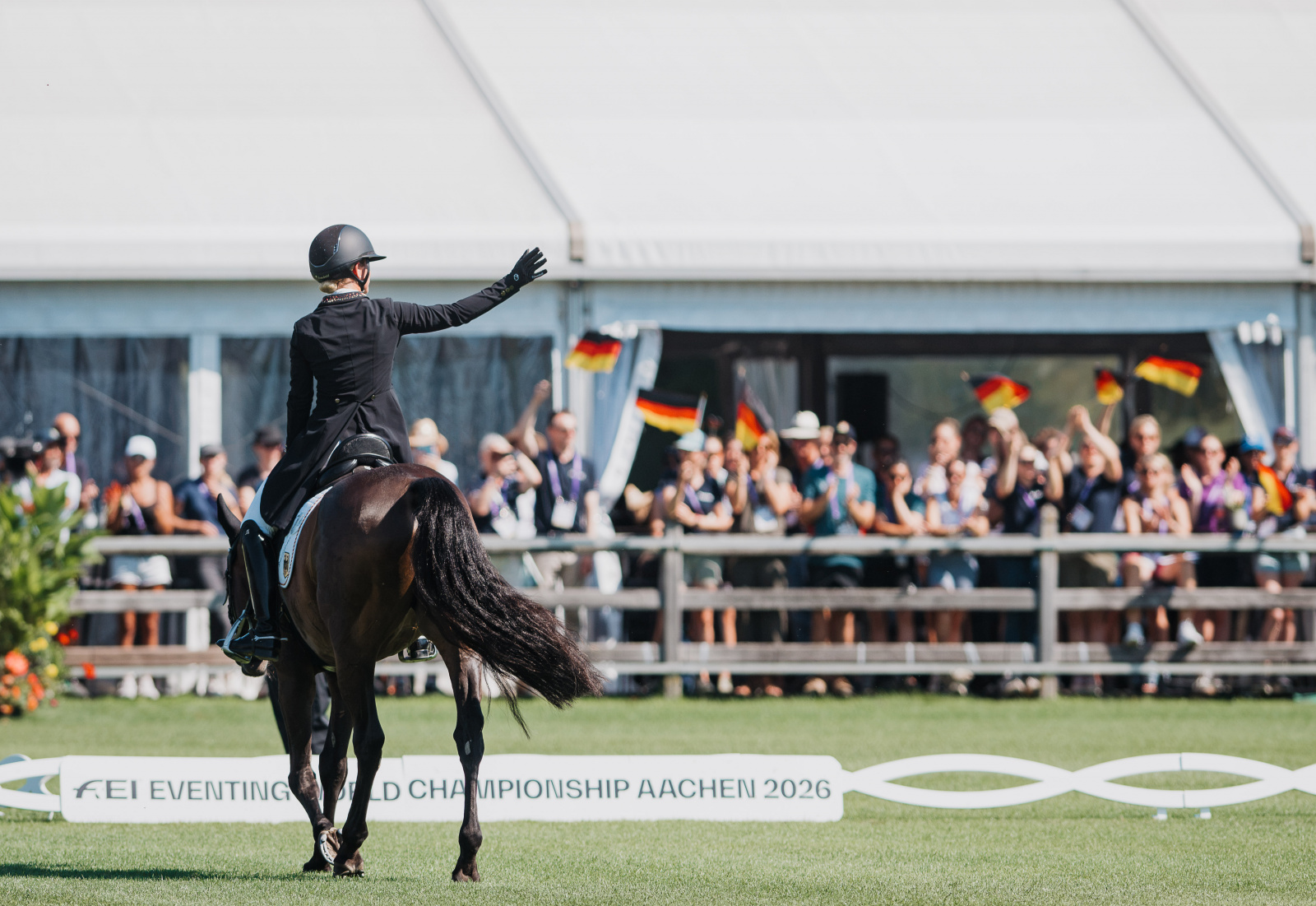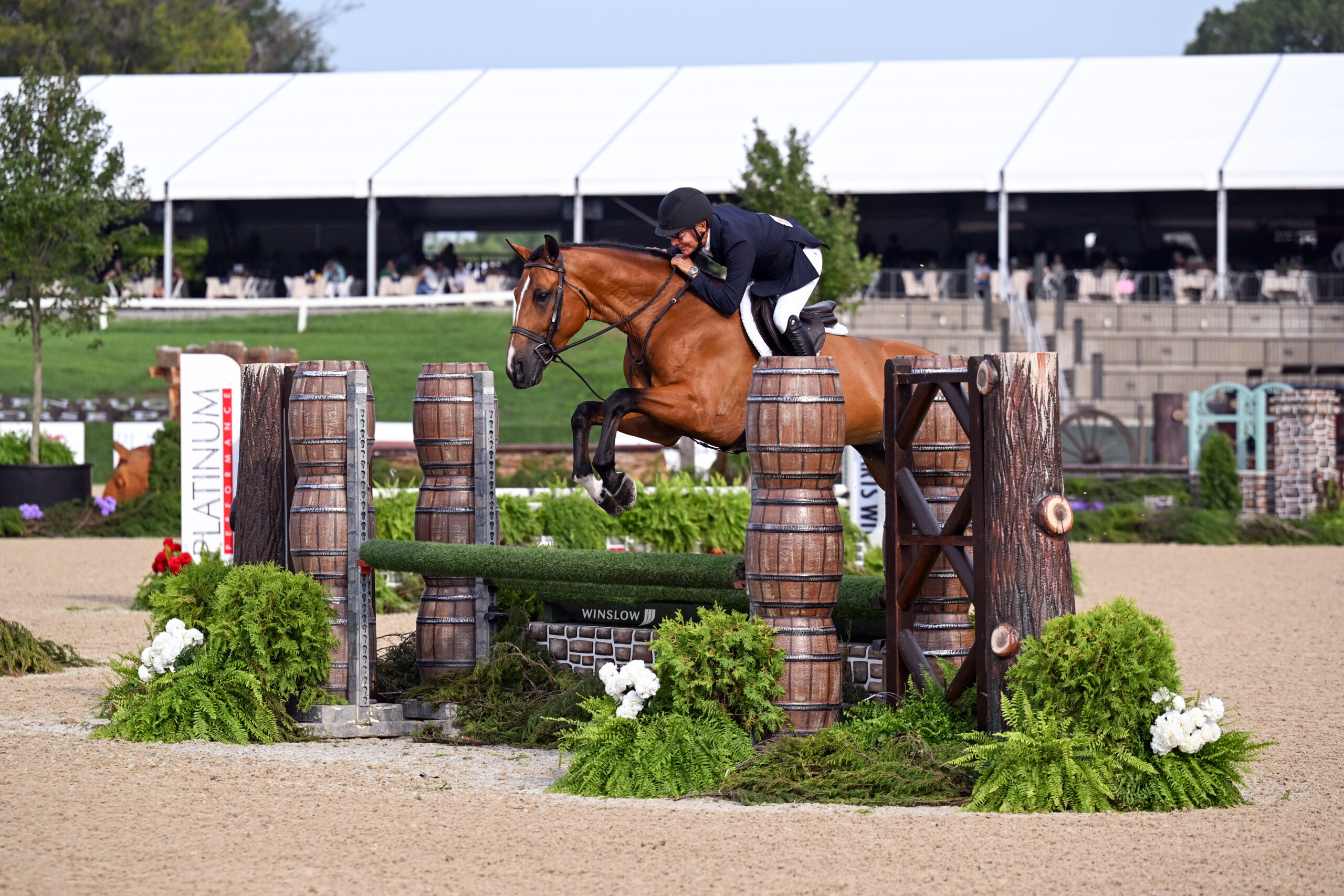


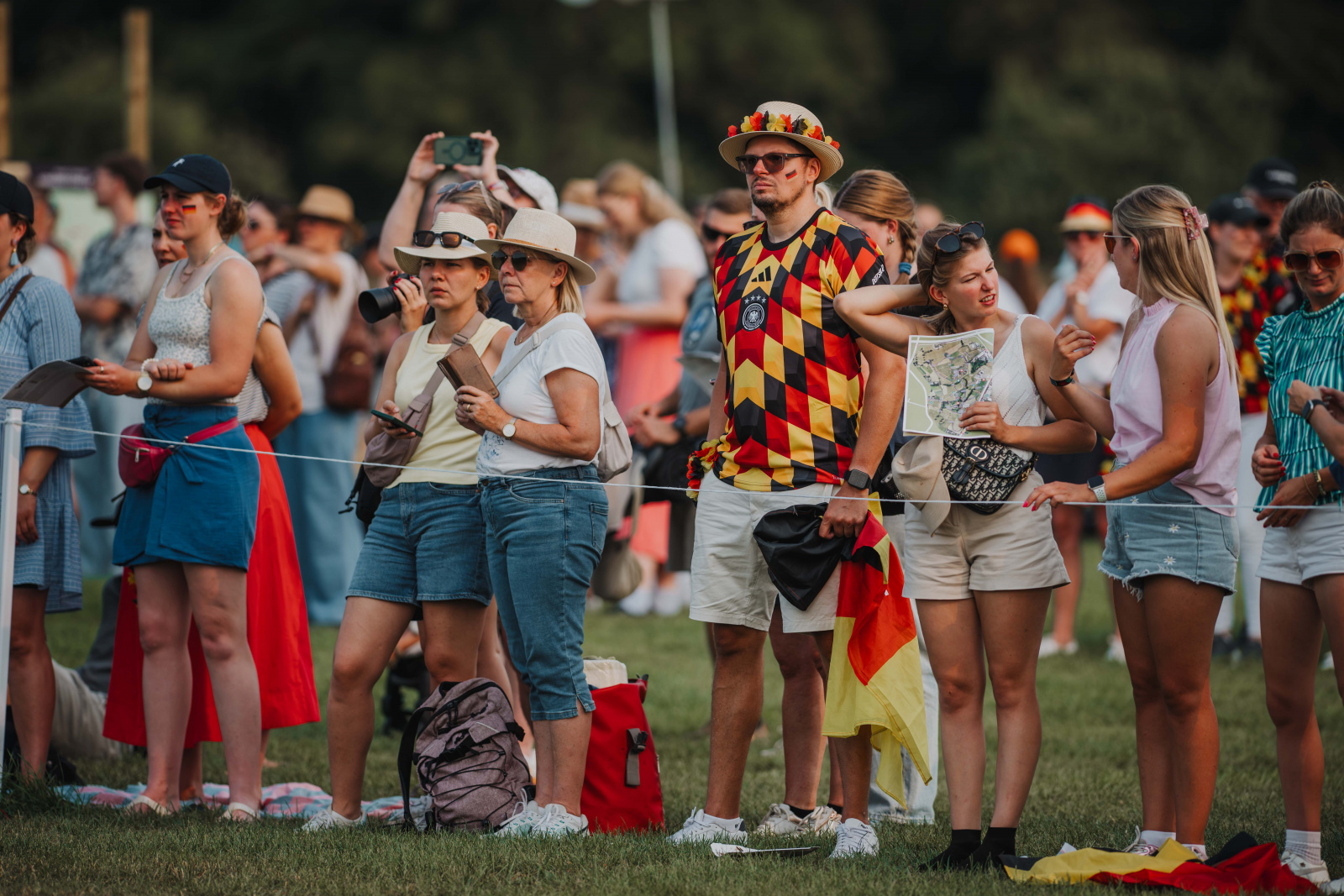

If you’ve never been to Aachen before, allow us to set the scene. There are 35,000 people crammed into a space the size of a singular loop of Badminton’s cross-country course; they are packed in like sardines, sweating and screaming and excited and so, so multilingual as they patronise their pretzel stands and quaff their morning Radlers. The German team supporters are, inexplicably, wearing t-shirts that have been typeset in Comic Sans, which somehow seems like the worst possible font choice for a sport that’s effectively the X Games with hooves – next year, we fear, they may have discovered webdings or, ugh, Papyrus.
Somehow, everywhere you look there is always an Australian, and the thing with Australians is that if you can see one, there’s definitely at least eight hiding nearby that you just haven’t found yet. To lure them out, you just need to use their mating call, heard time and time and time again over the course of the day:
“AUSSIE AUSSIE AUSSIE!” shouts one of them, somewhere, because maybe an Australian rider is coming by or maybe they’re just having a nice time.
“OY OY OY!” shout all the others, their curly-accented cries floating up through the trees.
The Germans do not know what to make of this, and more than once, I overhear one trying to get involved.
“Genau,” they murmur, eyes sparkling with wonderment. “Oy, oy, oy – genau.”
There is a fervent sense of barely-tempered chaos to it all. There’s a lone tampon hanging out just to the side of the course, which someone has unwrapped and left to expand in the little smattering of rain like a little white rat with a hormonal bloat; there’s a group of tipsy Germans who’ve sacked off the genau-ing and have instead taken up the fun and good hobby of screaming their heads off as their riders attempt to battle through the course’s toughest combinations. Stride, jump, scream, stride, scream, scream, jump, scream. It’s a lot, actually.
So is the wildfire that’s raging about fifty minutes away, which makes itself known halfway through the day’s cross-country when a thick plume of smoke settles itself into the atmosphere and turns the air an ashy yellow. My lungs do not feel so good right now! Nor does my increasing awareness of the very concept of cognitive dissonance!
I write this both in the middle of an existential crisis – uh oh, we’re focusing on horse sport when the world is literally on fire and this show contentiously used generative AI to promote itself and oh my god we really do dump so much water on cross-country courses when most of Europe is locked into water usage bans – but also in the middle of eavesdropping on a conversation between two Dutch journalists who are currently debating whether Tim and Jonelle Price are siblings. Aachen! You’ve gotta try it.
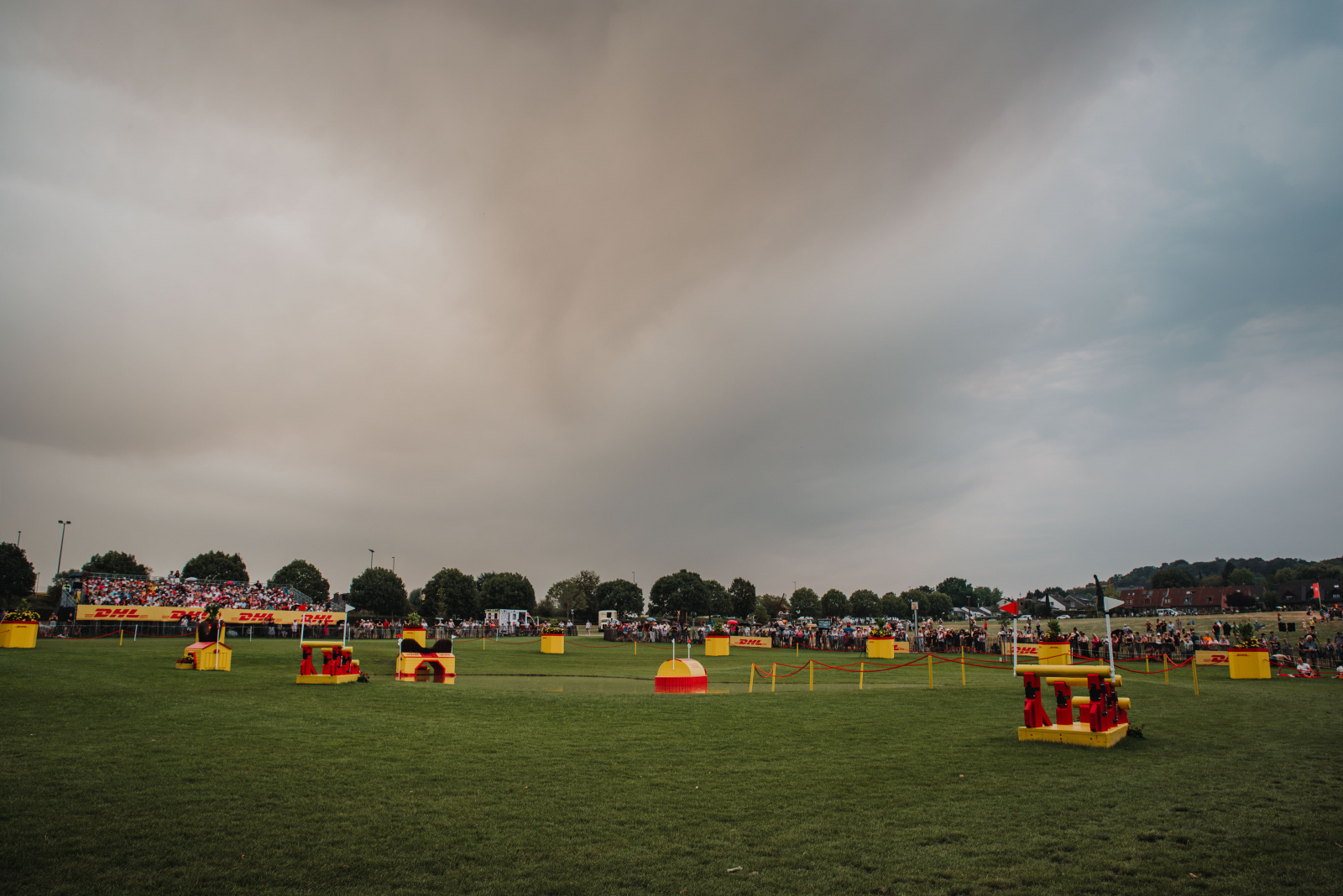
Photo by Tilly Berendt.
Anyway, the World Championships’ cross-country day. Let’s talk about that before the doom sets in or the ash settles in my alveoli.
Broadly, the consensus was that Giuseppe della Chiesa’s course had walked as fair but very, very exacting, with a trapped-in-the-tumble-dryer sort of twistiness that felt as though it could quickly become enormously mentally fatiguing.
That wasn’t necessarily disproven throughout the day, but the throughline of sentiment was a very positive one: rider after rider came back to the finish on fit, fresh, happy horses, and when they came to the mixed zone, it was to sing the praises of the course design.
It had, they agreed, had a flow and rhythm to it that hadn’t been totally apparent in their walks, and while it certainly caused its fair share of influence, it also offered such a wide array of options that it became a Choose Your Own Adventure to suit all comers.
From the earliest part of the day, though, it was plainly evident that little would remain the same on the leaderboard. While team pathfinders are chosen for their reliability – their role, of course, is to get home with a clear round and vital intel on the course’s tricks and traps for their teammates – many countries had to bid adieu to their first combinations after a series of mishaps.
For New Zealand pathfinder and second-on-course Clarke Johnstone and Rocket Man it was a surprise nosebleed (for horse, not rider), which saw the pair pulled up by the ground jury just after fence 11 in an otherwise very good round. For France’s first-out Benjamin Massie and Figaro Fonroy it was a shock runout at the skinny A element of the Turkish Airlines quarry complex at 9ABC, which subsequently saw the gelding overbalance on the changing terrain and fall on the flat. For British pathfinders Gemma Stevens and Flash Cooley it was a stop, and then another two, at the influential white birch coffin combination at 8ABCDE, before hacking home. Belgium’s Senne Vervaecke and Google van Alsingen, like Gemma Stevens and indeed just moments before her, ran into trouble at the coffin complex too, picking up three refusals and ending their round at 9A.
And then there were the first-round riders that completed, but with expensive errors on their score sheets: Germany’s Libussa Lübbeke and Caramia FRH, who picked up 9 penalties for a flag at 11C; and Sweden’s ordinarily very consistent Sofia Sjoborg and Bryjamolga van het Marienshof Z, who lost a front shoe at just fence 6 and had a subsequent rare 20 penalties at 9B.
But amongst the orgy of gasping and sighing and gnashing of teeth from 35,000 people shoved into a square kilometre or so, there was also the chance to glimpse the sort of heroics that weave their way into a day of cross-country.
We’d wondered if perhaps the time would prove uncatchable today – at the CCIO4*-S that’s held here every summer, it’s a huge factor, and just a handful of competitors have ever caught it. A CCI4*-L ordinarily offers a different sort of speed test, opening the door for a galloping type with plenty of stamina to catch up on the clock, but that doesn’t really fly for a CCI4*-L track that barely travels outside the already tight confines of the CCIO4*-S course. This, instead, felt like two of the ‘normal’ Aachens shoved together. If nobody had caught the 9:50 optimum time, nobody would have been at all surprised.
But just five starts into our day, somebody did it. That was Australia’s pathfinder Sophia Hill, who’s known for her blistering speed with the ex-racehorse Humble Glory – but while they’ve racked up plenty of five-star miles together, both horse and rider were as-yet-untested in the unique intensity of a championship.
When they crossed the finish line with five seconds to spare, it felt as though the game could truly begin.
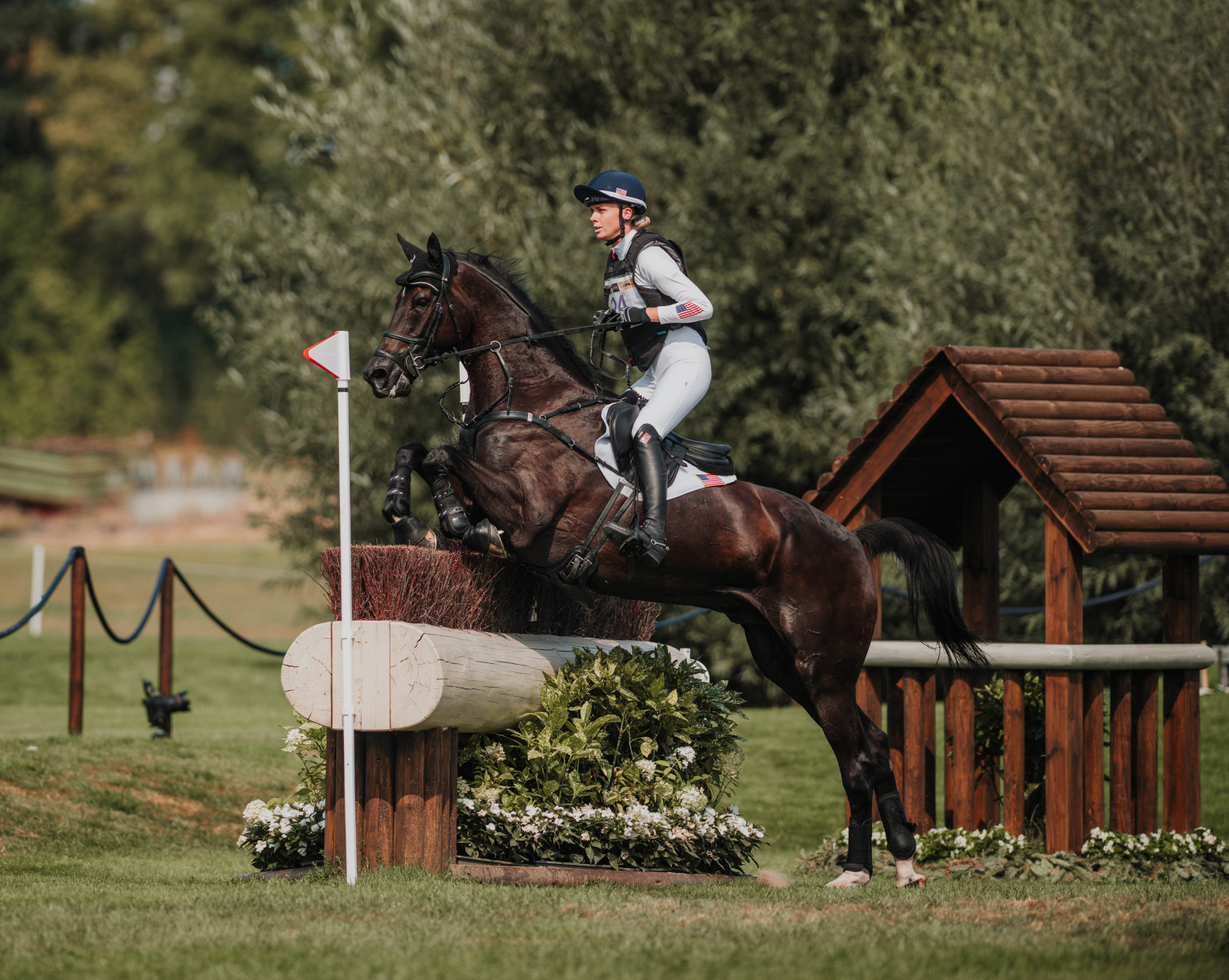
Caroline Pamukcu and HSH Blake. Photo by Tilly Berendt.
And so the day progressed: for every five shocks and leaderboard plummets there’d be another couple of extraordinary career highs. There was the gutting moment when US second-out Caroline Pamukcu tumbled from HSH Blake at the Longines bank complex at 17ABCDE where they, like most of the rest of the US team, opted to go long, but left a leg and pitched on landing, ending an important round for the team and forcing Will Coleman and Boyd Martin to leave nothing on the table later in the day.
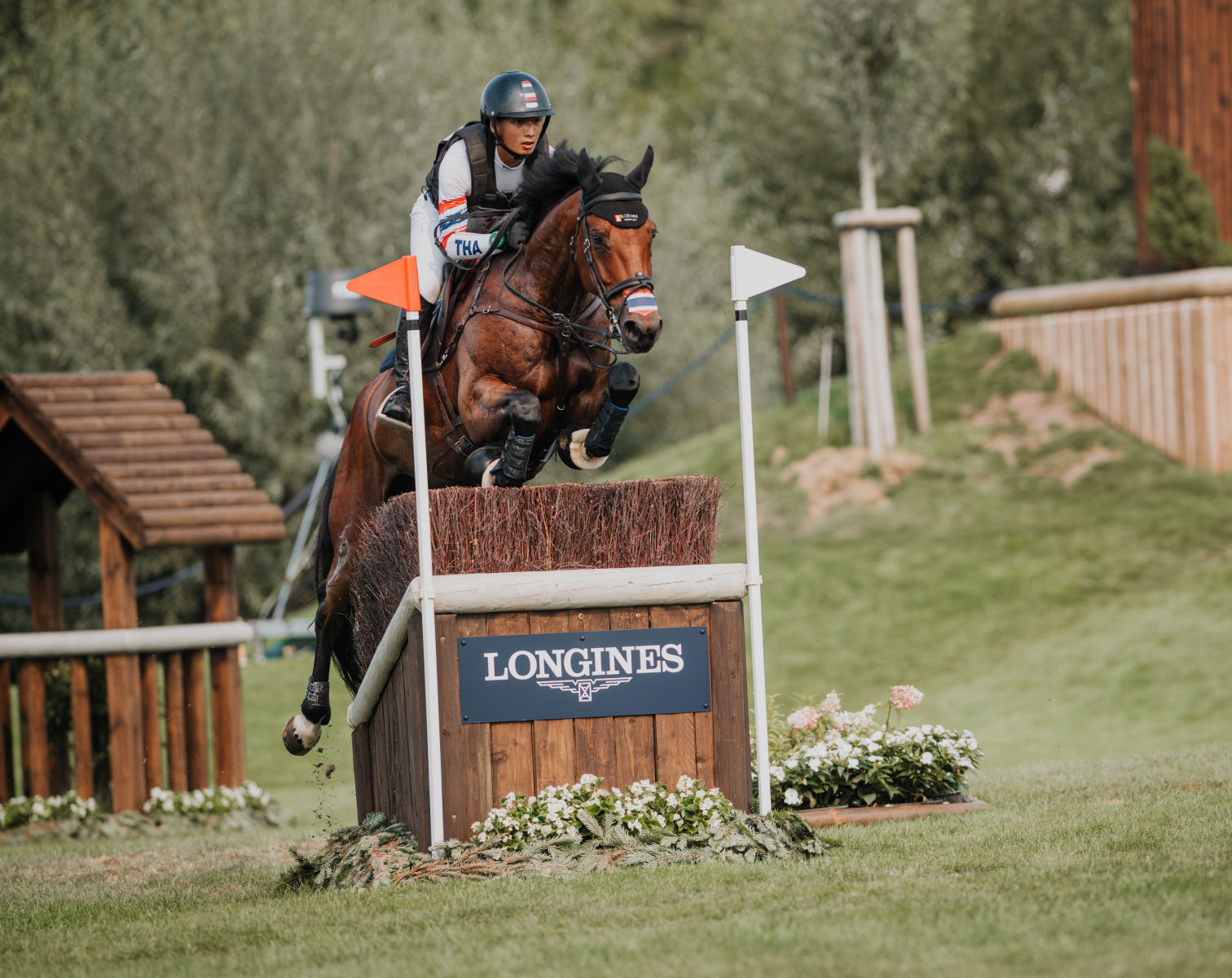
Kortawat Samran and B. Grimm Carouzo Bois Marotin. Photo by Tilly Berendt.
But on the other side of the coin, there was an impeccable effort from Thailand’s Korntawat Samran, who demonstrated that he’s one of the sport’s most underrated riders when he added just 1.2 time penalties with B. Grimm Carouzo Bois Marotin.
There was the moment when Jonelle Price was stopped on course so the building team could fix a frangible device, but something went wrong in the communication of that stop and she was barely strides away from the fence when she had to pull out of it; there was the knock-on effect of that oddity when, just two fences from home, her mount Senor Crocodillo picked up 20 penalties after never quite regaining his flow and focus. But conversely, there was Switzerland’s Mélody Johner and the still inexperienced Erin blitzing their way to a clear inside the time, driving the developing nation to an overnight bronze medal position. Push and pull, back and forth, gasp and cheer all day long. It was, in short, a rather good day of sport.
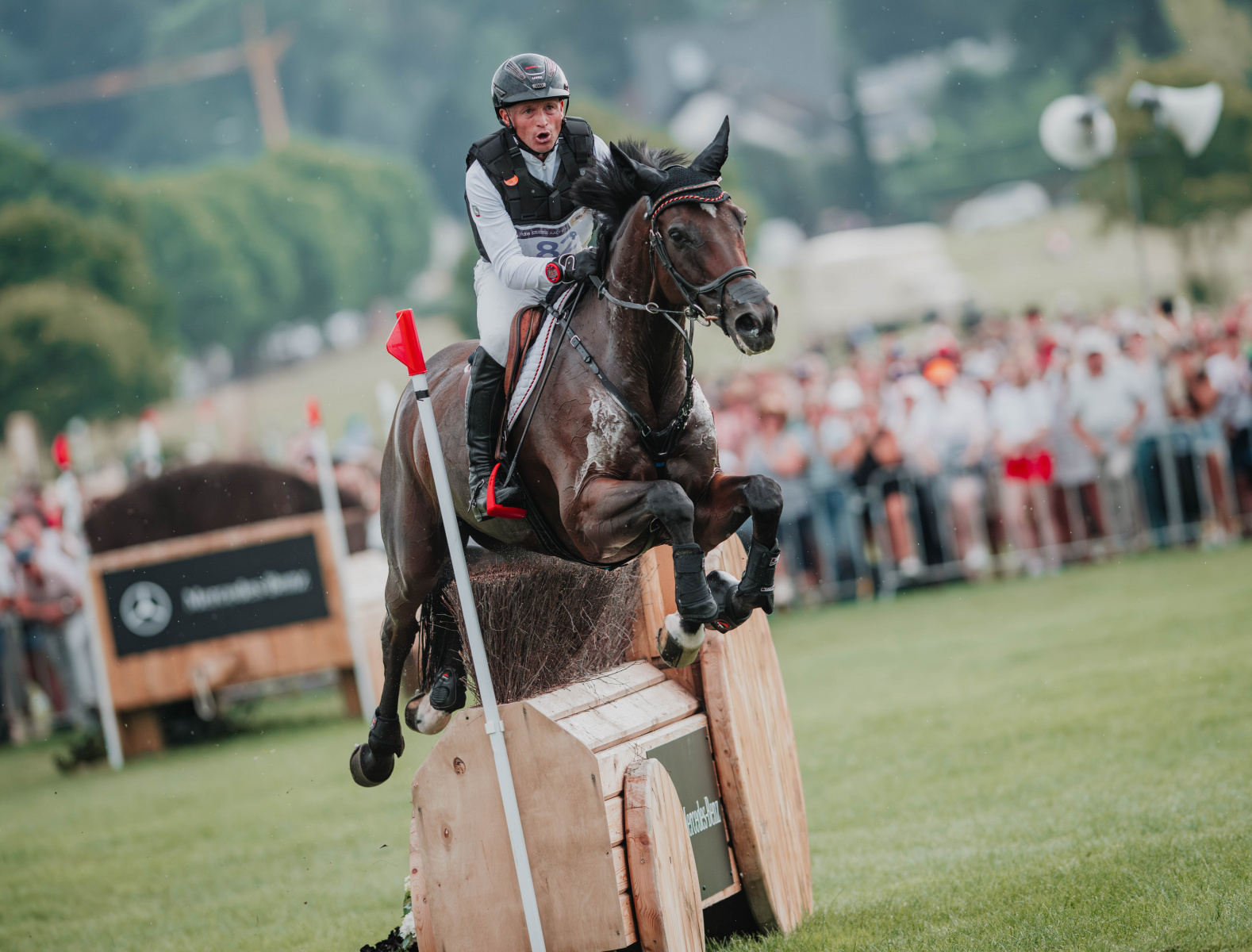
Michael Jung and fischerChipmunk FRH. Photo by Tilly Berendt.
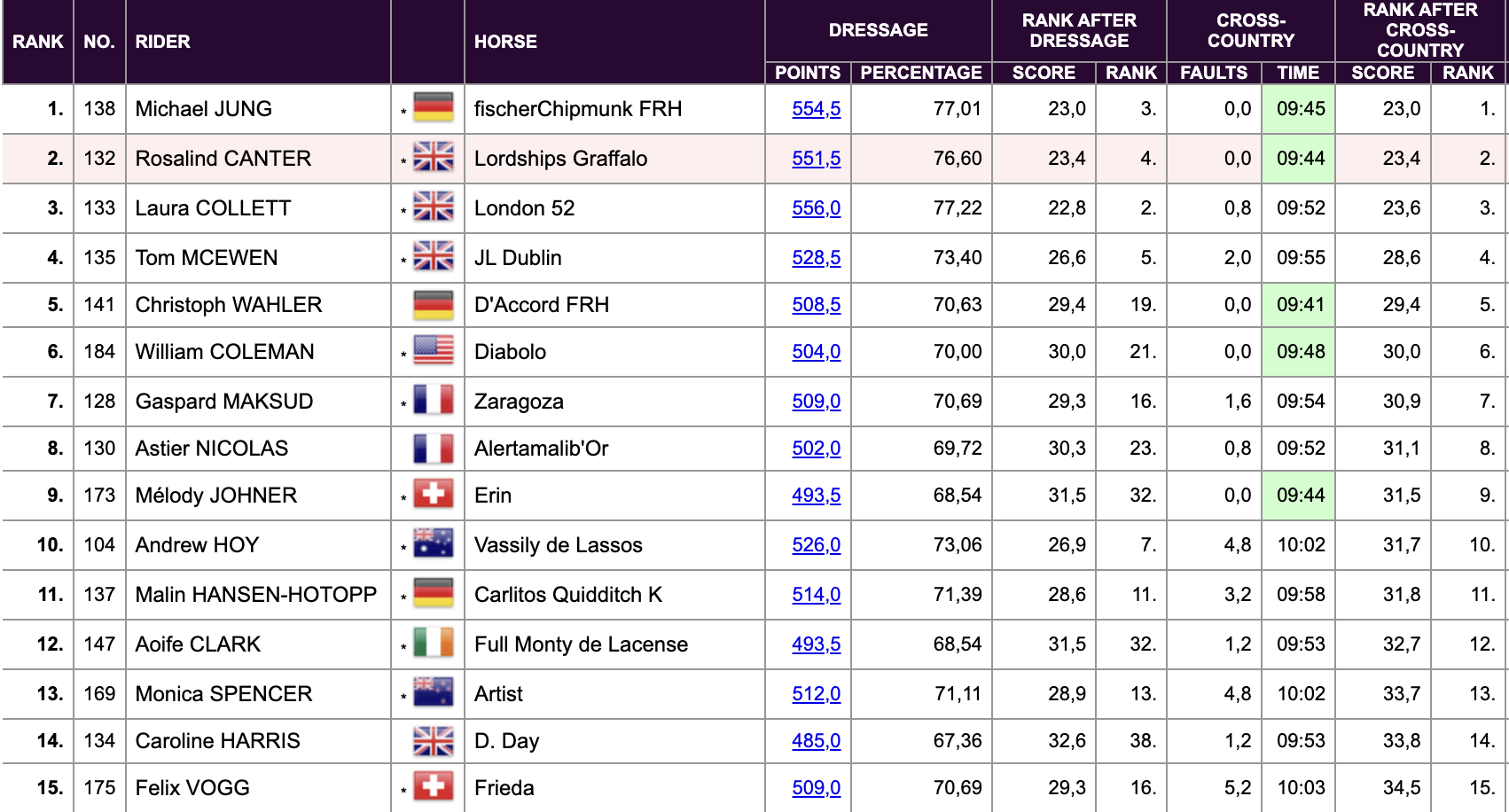
At its climax, we also have a new leader in Michael Jung and the eighteen-year-old fischerChipmunk FRH, who finished five seconds inside the optimum time in the gelding’s swansong championship to step up from overnight third, after dressage leaders and teammates Julia Krajewski and Uelzener’s Nickel added 13.6 time penalties to slip to twentieth.
“I have no words,” says Michi, who pushed through a bad case of the Aachen lurgy to make his round today happen. “He’s an unbelievable horse. He’s full of energy, he’s galloping, he’s jumping. He was so well listening today, and was so lovely to ride. He has all the experience. It’s such an honor to have this horse.”
Although Michi’s late draw – he was, predictably, the German team anchor and went in the final group of the day – meant he was aware of many of the course’s quirks, he left the start box firmly sticking to plan A.
“There were no changes to the plan, because the ground was perfect and the conditions were perfect, so it wasn’t like we said, ‘oh, the ground is shit in this place and we need to have another strategy,’” he says, proving once again that other people’s problems are evidently none of his business.
“I watched many other riders, and we all had conversations about our strategy and the course and the horses, and then we all fought together and had a really good cross-country day,” says Michi.
Part of his strategy was to do as little as possible.
“My horse is an older horse now, so I don’t do so many warm-up jumps because he also knows everything. I just need a good warm-up. At home he also doesn’t need cross-country or jumping training like a younger horse, but this is a bit the same with every horse. I think he’s an incredible horse; sometimes he can be a bit over-motivated, but today he was so nice to gallop at the start. I could loosen the reins and let the power out and have a super first jump into the cross-country, and that was a super start and a super feeling from the beginning.”
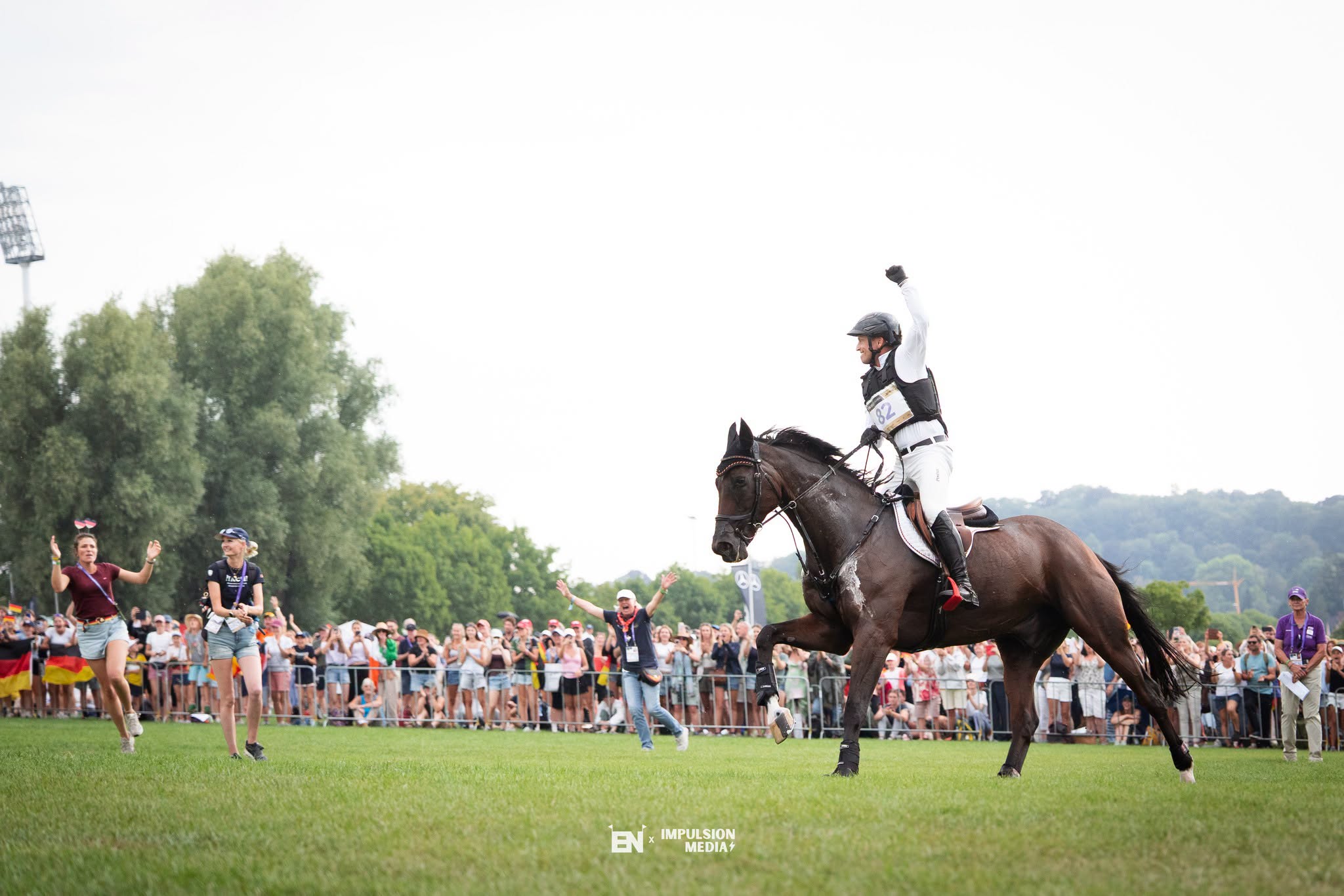
Michael Jung and fischerChipmunk FRH. Photo by Haley Boothe / Impulsion Media.
Michi was one of several riders who had voiced some questions around the course yesterday but found himself convinced by it today – but even so, he maintained that besting the clock didn’t come easily at all.
“The time was quite difficult to plan,” he says. “In the beginning, I was good from the time. Then I was thinking, ‘ah, maybe I’m a bit too slow,’ and then ‘okay, the time was good,’ and then ‘I’m not sure.’ The time is not everything; you need to see the whole course, and that’s the difficult thing. If you go too fast in the beginning and you have no energy in the end, the last jumps get so difficult. Nearly everywhere you can have a mistake if you take too much risk or you’re going too fast. So the time is not everything, but the feeling into the horse and how he’s galloping, how he’s breathing, how he’s confident on the jumps, how much you can try. Sometimes it’s better to give the horse a few seconds to stay in a good balance, in a good feeling. Then in the end, I was fighting a bit more, and he was absolutely with me, and that’s a great feeling.”
Just one second swifter than Michi and Chipmunk were five-time five-star winners Ros Canter and Lordships Graffalo, who won the European Championships in 2023 and come into this competition as one of three titans of the sport – all of which find themselves in podium positions going into Sunday.
That speedy, confident clear moves them into overnight silver medal position, up from the fourth place spot they occupied after putting a 23.4 on the board yesterday.
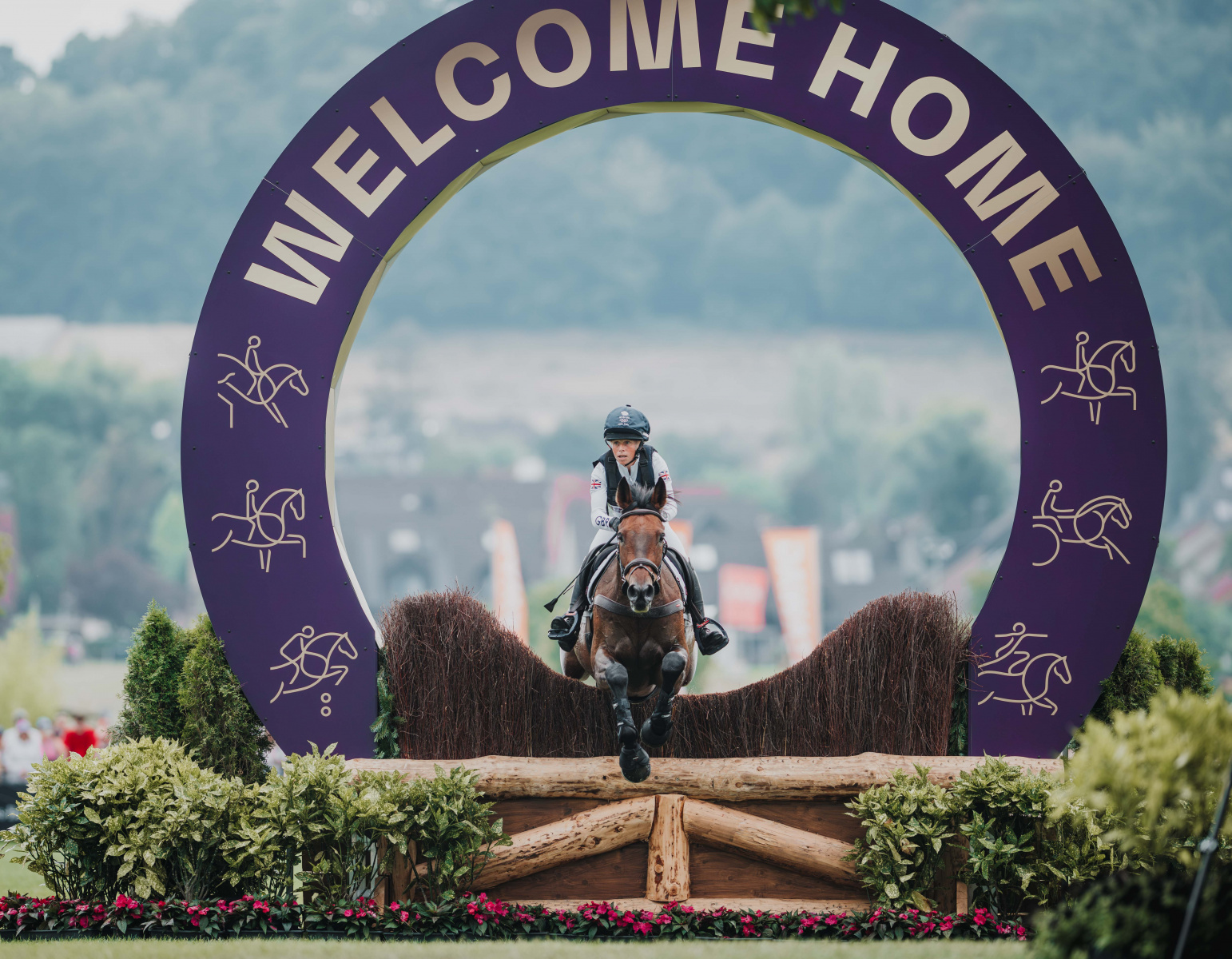
Ros Canter and Lordships Graffalo. Photo by Tilly Berendt.
“I’m quite relieved, to be honest,” says Ros, who was the day’s final finisher on cross-country. “It’s been a long wait today, and it’s a very, very intense track to ride. The Badmintons and the Burghleys feel a little bit easier for Walter because you can cruise along in between the fences, whereas today you have to go so fast in between and there doesn’t seem to be any space to go, because all of a sudden you’ve got another jump to jump.”
But, she continues, “what an amazing horse he is. He just absolutely loves it, doesn’t he? His ears are pricked and he just gives me the utmost confidence.”
Ros’s fast round came down, in part, to some last-minute self-discipline.
“I saw Tom [McEwen] kind of go the long route at the last corners and I had that in my mind – even coming out of the last water I was really, really tempted to go long because he just felt like he’d gone a little bit strung out. But then I was like, ‘for goodness’ sake, you haven’t come to the World Championships to wimp out of it! Get on with it; you’re on a good horse.’ I’m really pleased I made that decision.”
This is Walter’s first spin around Aachen; Ros, for her part, hasn’t been here since coming several years ago with her 2018 World Champion Allstar B. This time, she returns as the sport’s consummate multitasker: second child Seneh, who was born in late January, even took part in the show’s opening ceremony earlier this week.
“I’m still breastfeeding, and it’s [a lot to juggle], but I wouldn’t change it for the world,” says Ros. “I’m absolutely loving being able to combine the two, and I think it’s actually amazing just looking around the stables this week at how many children are involved in everybody’s teams now. It’s a proper family affair across all sports, and I’m not the only that’s just had a baby that’s going around the eventing. It’s fantastic to see that we can do both.”
Ros’s older daughter, seven-year-old Ziggy, is notable only by her (planned) absence this week.
“She’s stayed at home, because she’s a bit of a shopaholic and I think she’d have gone a bit mad in the shops here,” says Ros wryly. “She’s got a very packed itinerary, though, and she’s having a wonderful time. She had Pony Club camp yesterday and was very disappointed because she was in last place after dressage. She thought it was the judge’s fault, not hers, so she’s got a little bit to learn!”
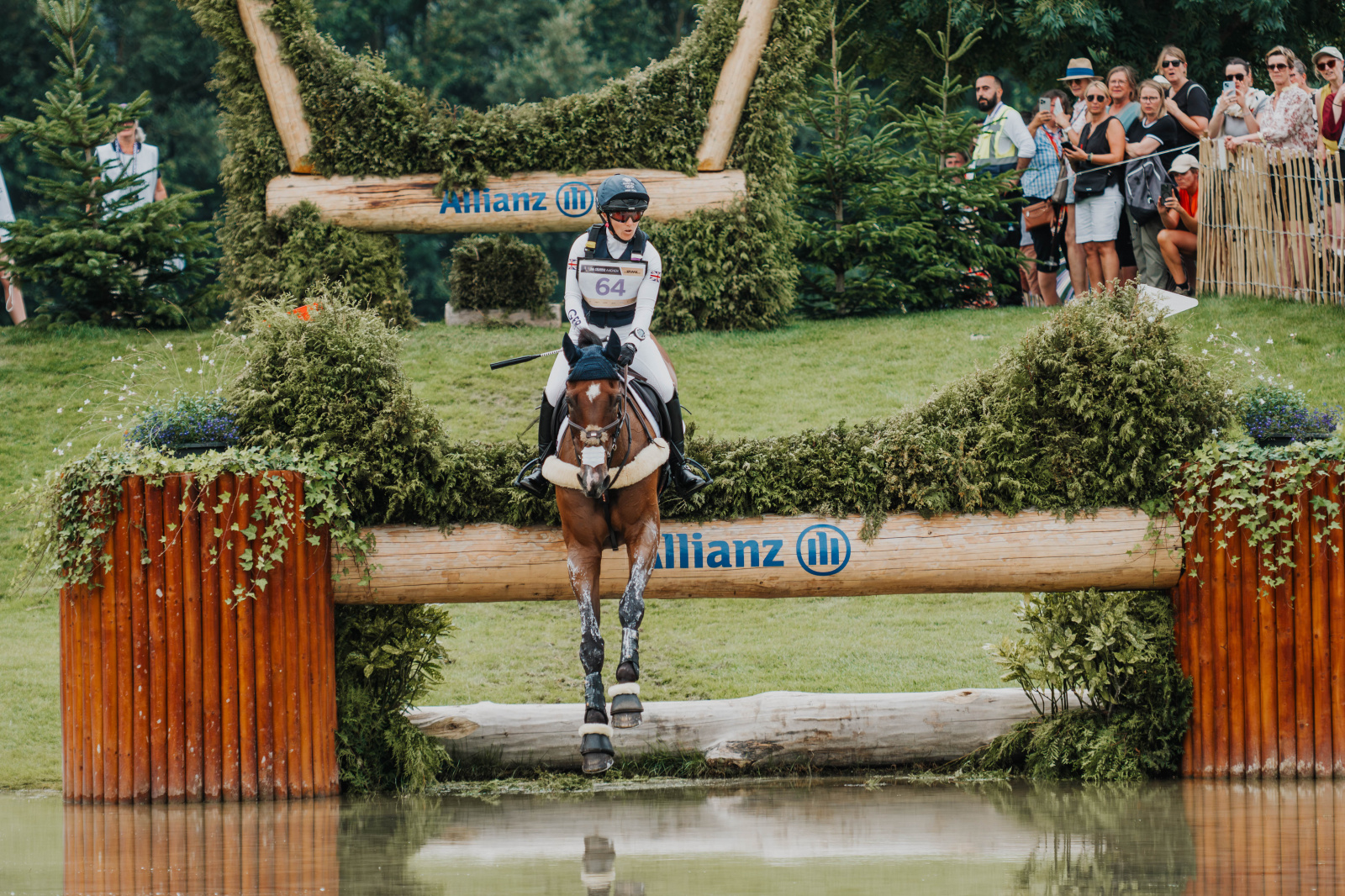
Laura Collett and London 52. Photo by Tilly Berendt.
The third of those sporting titan pairings, Laura Collett and her European champion London 52, move from silver to bronze position after adding just 0.8 time penalties for two additional seconds on the clock – an addition that still puts them just six-tenths of a penalty behind our overnight leaders.
“That horse is just unbelievable,” she says. “He felt like he’d walked the course and knew what I was wanting him to do before I even got there. He gave me so much confidence from start to finish and never wavered off the line.”
They did, she admits, have “a bit of a scary moment, because he pulled a shoe and turning to the last water, he literally nearly was on his side. And I don’t know how he jumped quite a big fence into water, but he is just the most amazing horse. The ground looked very close at one stage, and I was like, ‘not on a turn!’”
Like Ros, Laura had to battle the urge to add an alternative route after teammate Tom did it so successfully earlier in the day.
“Obviously Tom went long at the last combination, and it was very tempting to play it safe. But I just thought, ‘you know what, this horse is on fire.’ He was reading everything, and he felt so with me that I could just trust him 100%, and I’m glad I did. I was always going long off the bank [at 17ABCDE, where most competitors opted for the long route] and then, having watched a few this morning, the three strides in that route just looked so short. Then Tom [went straight and] made it look so easy, and he said he felt like he had loads of time. So Chris [Bartle] grabbed hold of me and said, ‘go straight. I believe in you.’ The feeling I was getting, there was no reason to doubt him.”
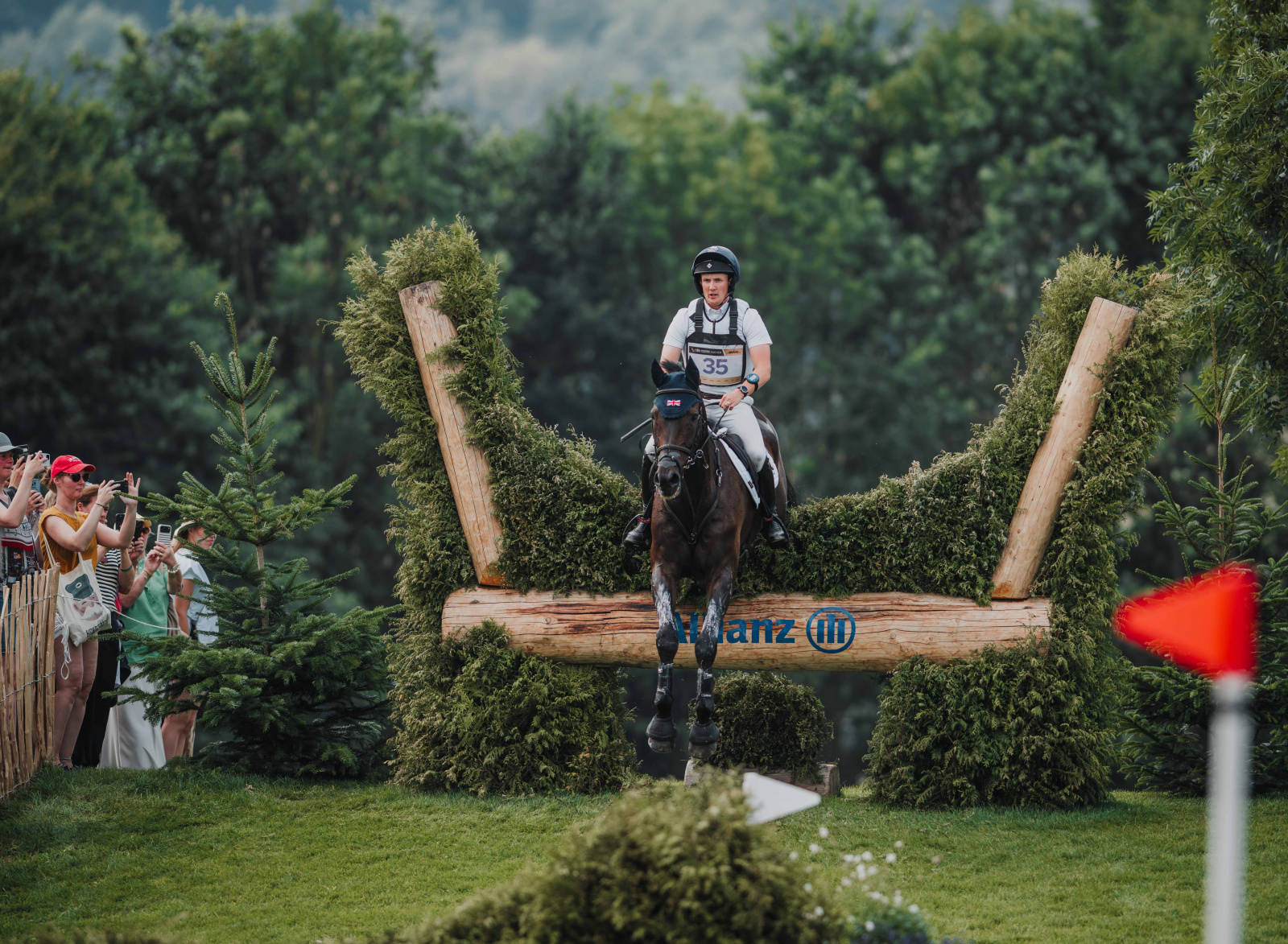
Tom McEwen and JL Dublin. Photo by Tilly Berendt.
Tom, for his part, sits in fourth place after that speedy round with JL Dublin, despite taking the long route at the final combination. They added 2 time penalties to climb up one position, though their overnight score of 28.6 does leave a broad margin of five penalties between his current placing and a spot on the podium.
“I couldn’t be happier,” he says. “Dubs knows what he’s doing, but with the crowds and the people they all get excited, and it walks a decent track. It needs a lot of riding; you’ve got flags everywhere; the corners are skinny. But Dubs, for me, went brilliantly, and I just let him sail – never at one point did I think I was rushing.”
As he approached that late combination, “I was hoping to feel enough on top to go the direct route, but for me, he felt a bit like we were going away from home again, so I made the quick decision to go a bit lower and speed as quick as I could round the long route. With three in the team, the team comes first, and I thought I’d better just get that done and sorted.”
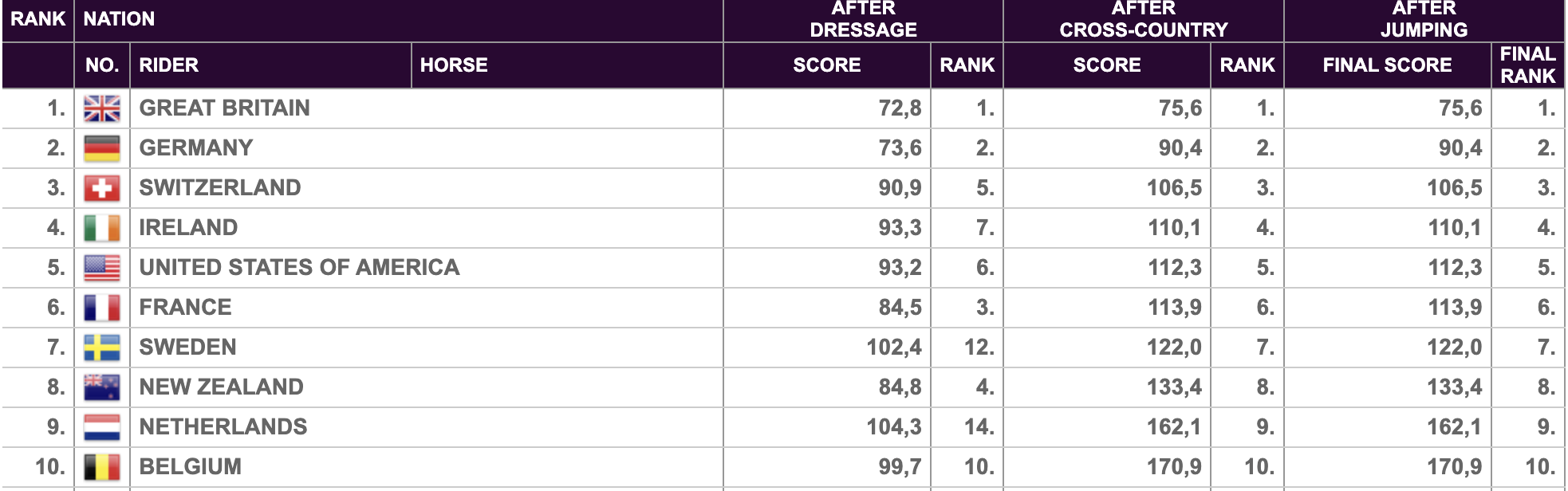
That sensible decision helps confirm the British hold on team gold overnight on a combined score of 75.6 – just shy of 15 penalties ahead of Germany in silver. The surprise decision to put the experienced Christoph Wahler and D’Accord FRH into Germany’s individual spot, rather than the team, might now feel rather frustrating; Christoph and the rangy gelding once again caught the time, crossing the finish line in a time of 9:41 to move up from 19th to fifth place.
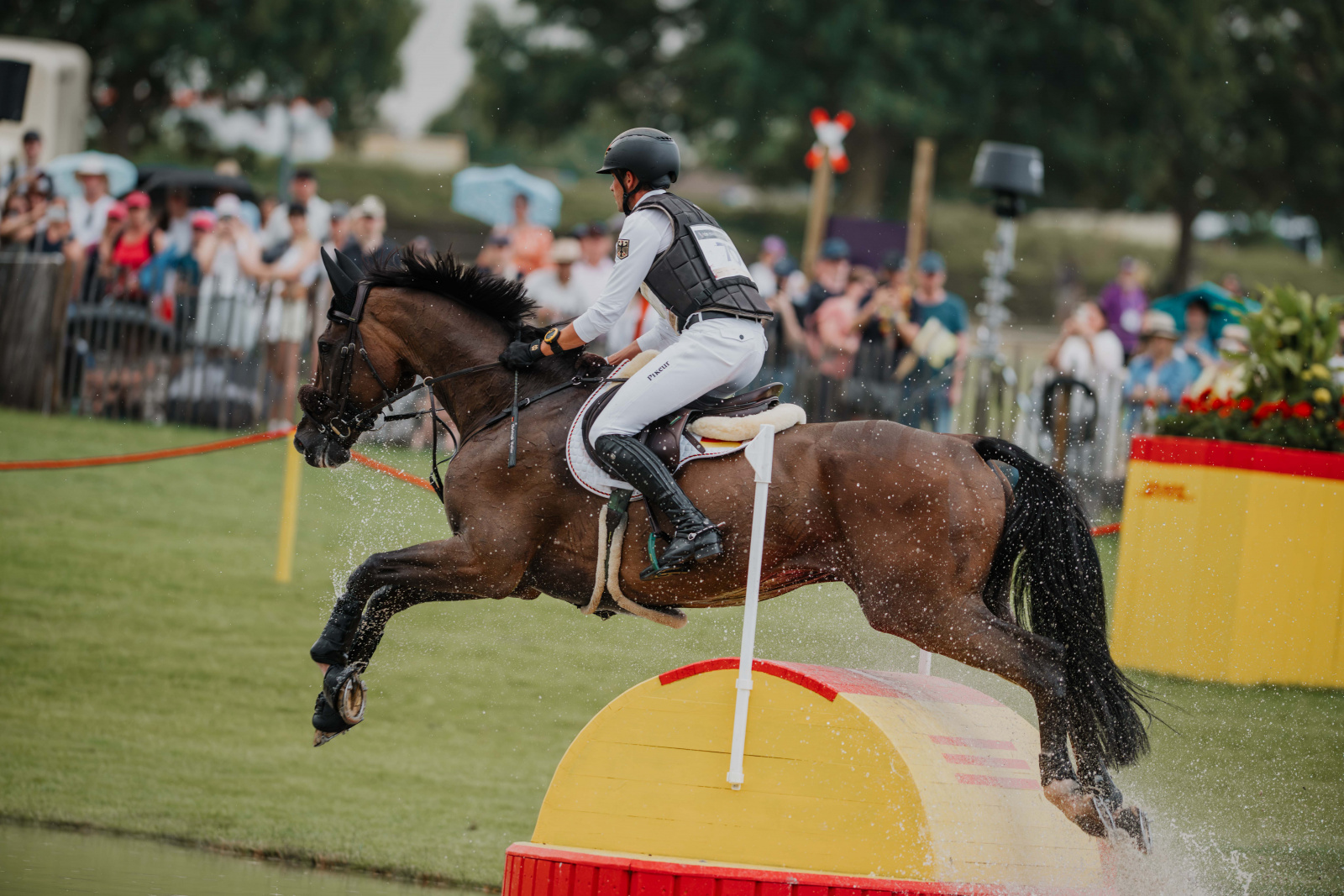
Christoph Wahler and D’Accord FRH. Photo by Tilly Berendt.
“That’s his big talent: he’s the fastest horse I’ve ever been on,” says Christoph. “And if you can manage to jump the fences, and if the rider manages to find all the right ways, then he’s always going to make the time.”
But, he says, they nearly lost it at the eleventh hour when approaching the final water fence at the same time as another rider approached neighbouring fence three.
“I was a bit surprised with having a rider coming the opposite way, approaching fence three, when I was approaching the last water, directly when I was turning to the left to jump in. Then D’Accord looked to the right [at the horse] and lost sight of the fence. Unfortunately, I lost my focus because of that, and then we had a very bad jump going in, lost our line, had to wiggle our way over the last skinny — that was a bit surprising. He was brilliant, though. He’s very big, but he’s got very fast footwork.”
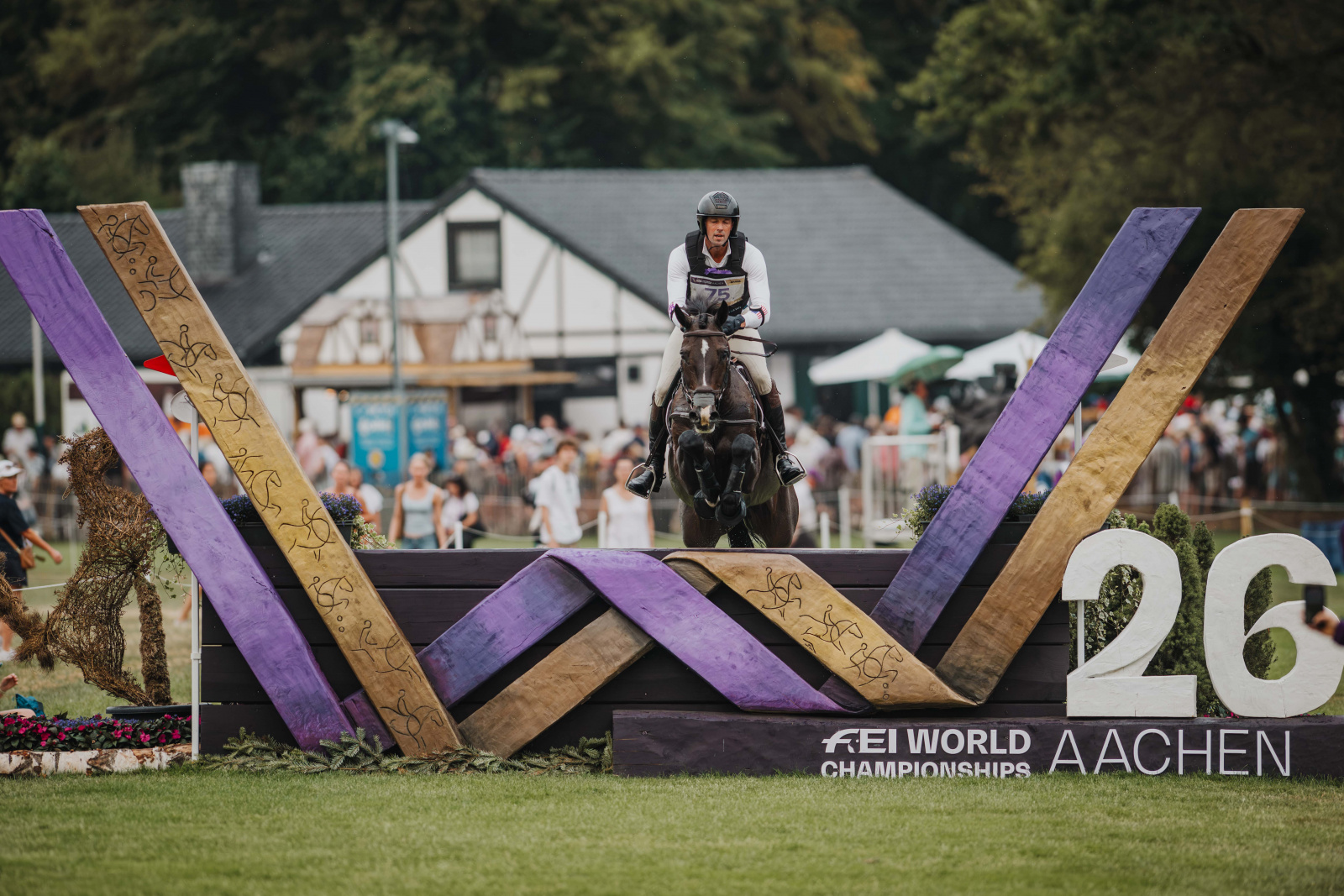
Will Coleman and Diabolo. Photo by Tilly Berendt.
US team anchor Will Coleman and his Kentucky five-star winner Diabolo needed to execute a clear round in as swift a time as possible after the shock fall of Caroline Pamukcu earlier in the day, and after yesterday’s sweltering dressage day, when the gelding never seemed to truly come to work, there was plenty of pressure to turn it all around today.
But if Will felt it, you would never have guessed from his riding, which remained relaxed, nurturing, and positive without being pushy. That helped ‘Dab’ come home two seconds inside the time, one of just six horse-and-rider partnerships to catch it all day. That moved the pair up from 21st to sixth, and moves the US team from sixth to fifth place going into the final day.
“He was amazing — he was better than the rider today,” says Will. “I give him all the credit; he’s an amazing horse. From the first jump out of the start box, I just felt like he was just totally on it and kind of felt like I couldn’t screw it up. I can’t say enough good things about him as a horse and as a partner. He’s just amazing.”
“I don’t know where [his energy] has been all week,” he continues. “He can be a pretty hot horse, but he’s been very quiet. It’s been driving my wife and [groom] Erin [Jarboe] pretty crazy, worrying about him, like ‘is something’s wrong with him? Do we think he’s all right?’”
Today, in the slightly cooler temperatures, he was back at his best.
“He’s a really, really cool horse, and Aachen is a really intense cross country test. There’s places out there where I opened him up a little bit, and then I did sort of struggle to get him back the way I’m accustomed to. But it’s kind of that pace and that acceleration that I think he’ll get something out of doing this, and I think he’ll be better on these types of courses going forward. And so will I; I think I’ll have a better idea of how to ride him.”
Will holds the unique accolade of being the only US rider ever to win Aachen’s CCIO4*-L, which he did in 2022 with Off The Record. That, no doubt, played into the trust placed in his hands today, when the only option was excellence.
“There were no adjustments to the plan [after Caroline’s fall]. Karyn [Schuter] and Leslie [Law] trusted me to make good decisions out there. I told them I felt good about going the direct way off the bank, and they trusted me to do that so long as I felt like he was with me, and I did feel that. This is a team game, and I learned something from each and every one of those guys that went in front of me. Philip set us off on a great note with a fabulous round, and Caroline didn’t have the day that we all know she can have, but she still came back with a positive attitude and gave us all as much insight as she could give us, and has just been an excellent teammate every step of the way here. Tamie’s not with the squad, but doesn’t matter. She’s part of our team, and also has just been incredible all week. And Boyd kind of showed me the way to go. He gave our team a chance, and it’s kind of up to me to just try to bring us home a clear. And I was just really, really relieved that I did that.”
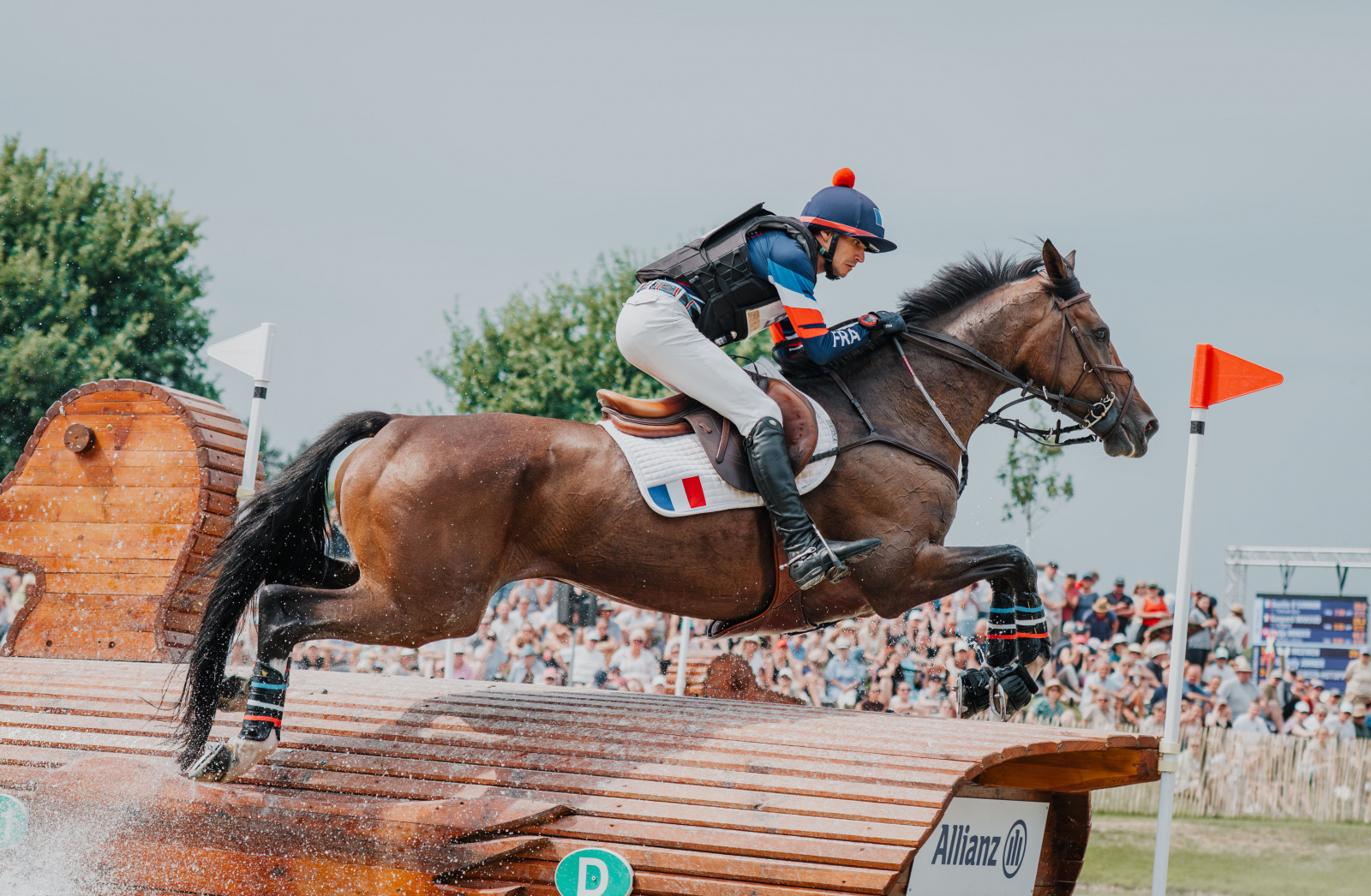
Gaspard Maksud and Zaragoza. Photo by Tilly Berendt.
France had been in bronze medal position after dressage but have slipped to overnight sixth after the elimination of Benjamin Massie and a surprise pin penalty for Nicolas Touzaint and Diabolo Menthe, but they finish the day with two riders in the top ten: team member Gaspard Maksud and Zaragoza sit seventh, up from 16th after adding just 1.6 time penalties, while individuals Astier Nicolas and Alertamalib’or, like Christoph and D’Accord, made a point when adding just 0.8 time penalties to step up from 23rd to eighth.
“She’s such a good mare — she’s a proper five-star horse,” says Gaspard, who was sixth and best of the French at Pratoni in 2022 with Zaragoza. “It just shows how consistent she is now, and we’ve allowed her to mature a bit to the best of her ability. Wejust grew together, and now it’s just pure pleasure to just enjoy having a horse at that level because she’s getting older, so we just enjoy every second of it.”
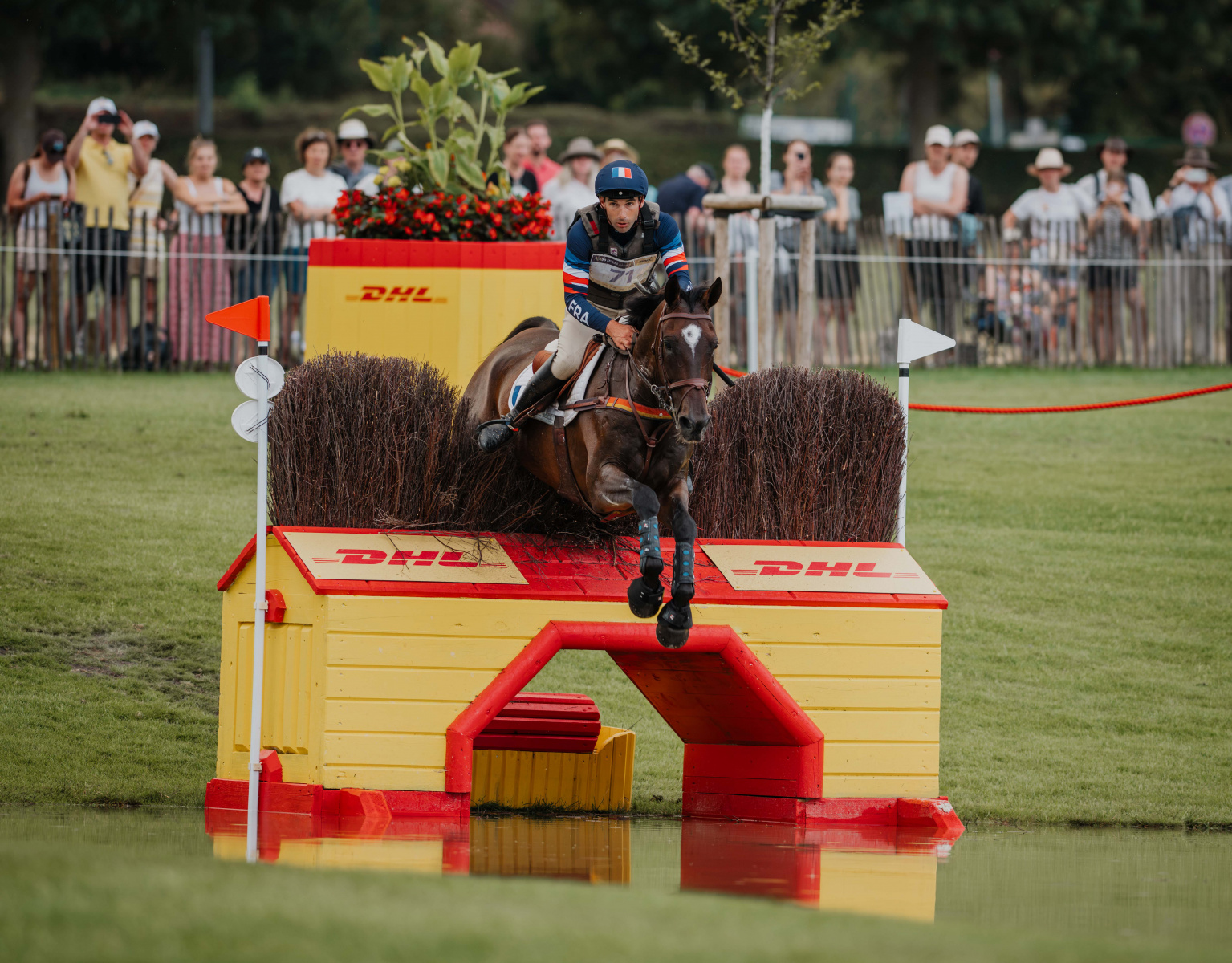
Astier Nicolas and Alertamalib’Or. Photo by Tilly Berendt.
Astier’s accomplishment in moving into the top ten is also paired with a unique achievement: he’s responsible for having produced four horses competing here this week. Beyond his own mount, there’s the stalwart Vinci de la Vigne, ridden by Kento Nagura, Baladin de l’Ocean LA, ridden by Turkey’s Kumru Say, and Boyd Martin’s Cooley Nutcracker, too.
“I’m proud to have produced them and a bit gutted not to ride them,” he says. “But you can’t get it all. Our job is to produce and bring on sale horses, so that’s what I do. But I’m pretty proud they do so well, and not only they’ve been competitive with me, but they’re produced in a way that allow other riders to follow them and do the top level.”
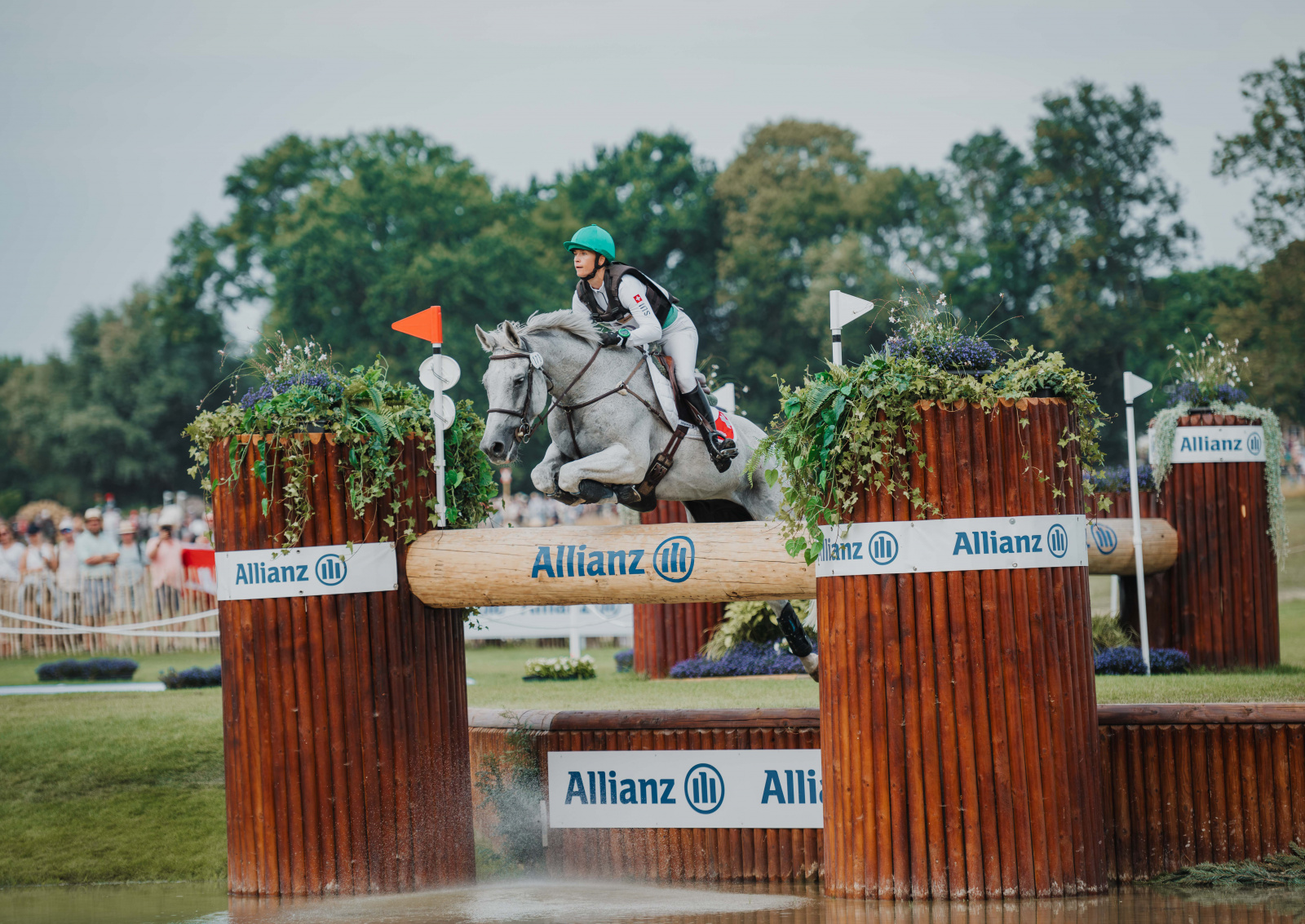
Mélody Johner and Erin. Photo by Tilly Berendt.
Switzerland, thanks in large part to leading rider Mélody Johner, finds itself in bronze medal position going into the final phase – a bid for a medal on the world stage that has felt so long in the making for the country. That Mélody’s clear inside the time comes with the relatively inexperienced Erin, rather than her former championship ride Toubleu du Rueire, also shows the depth in horsepower that’s beginning to develop through these riders’ strings – a heartening prospect for the future of Swiss eventing.
“He’s always fast, but here it was really special because he was really good, but not so strong,” says Mélody, who moved from 32nd place up to ninth. “I’m really little, and when he wants to go, sometimes I can’t slow down, but today he was really, really good. I don’t have to try to be fast; he has such a big canter stride, so even when we’re not pushing, he’s fast.”
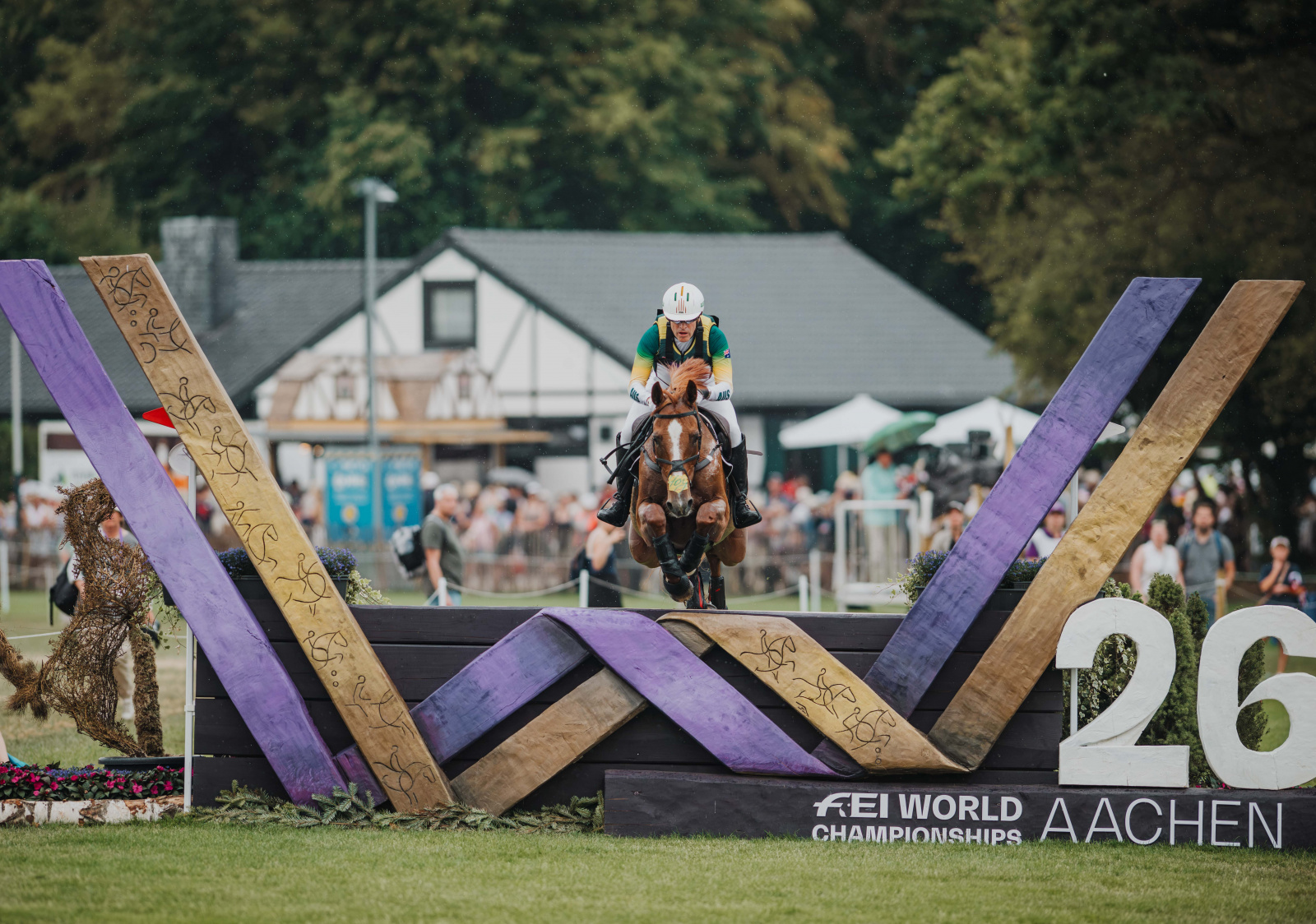
Andrew Hoy and Vassily de Lassos. Photo by Tilly Berendt.
Australia’s Andrew Hoy closes out the top ten after an excellent round with comeback king Vassily de Lassos saw them add just 4.8 time penalties, moving them from seventh to tenth but allowing Andrew to relive the rush of twenty years prior, when he was part of the team bronze medal at the 2006 World Championships here at Aachen.
“I think, in all honesty, could I have got the time? Yes. It’s about little things that I did that I could have done better,” muses Andrew, who carefully piloted Vassily home after the gelding lost a shoe around the seven-minute mark. “But Vassily is the most spectacular horse. I absolutely love my horse to bits. He makes me look really good, and to run round, I had to be on my A game all the way round. There was not one point, starting from when you leave the start line to when you get to the finish line, is there anywhere where you can say, ‘Oh, this is this is easy. I can now relax. ‘ It’s all the time, keeping the brain activated and really going.”
The team competition more broadly looks like quite a different landscape this evening: Great Britain in gold and Germany in silver is unchanged, but Switzerland’s climb to bronze feels like a huge moment, as does Australia’s drop to fourteenth after the non-completions of Oliver Barrett and Sam Woods. Japan, too, is out – they have no riders left in the competition at all after Toshiyuki Tanaka and Jefferson JRA’s non-completion and the post-cross-country withdrawal of both Kento Nagura and Ryuzo Kitajima. New Zealand, who were so close to a podium place in fourth last night, are now eighth with just three riders left in the hunt, while Sweden’s four completions allow them to climb from 12th to a slightly more promising seventh. Ireland’s excellent day in the office, with four clear rounds, pushes them from seventh to overnight fourth, just 3.6 penalties – less than a rail – behind Switzerland.
The North America Debrief
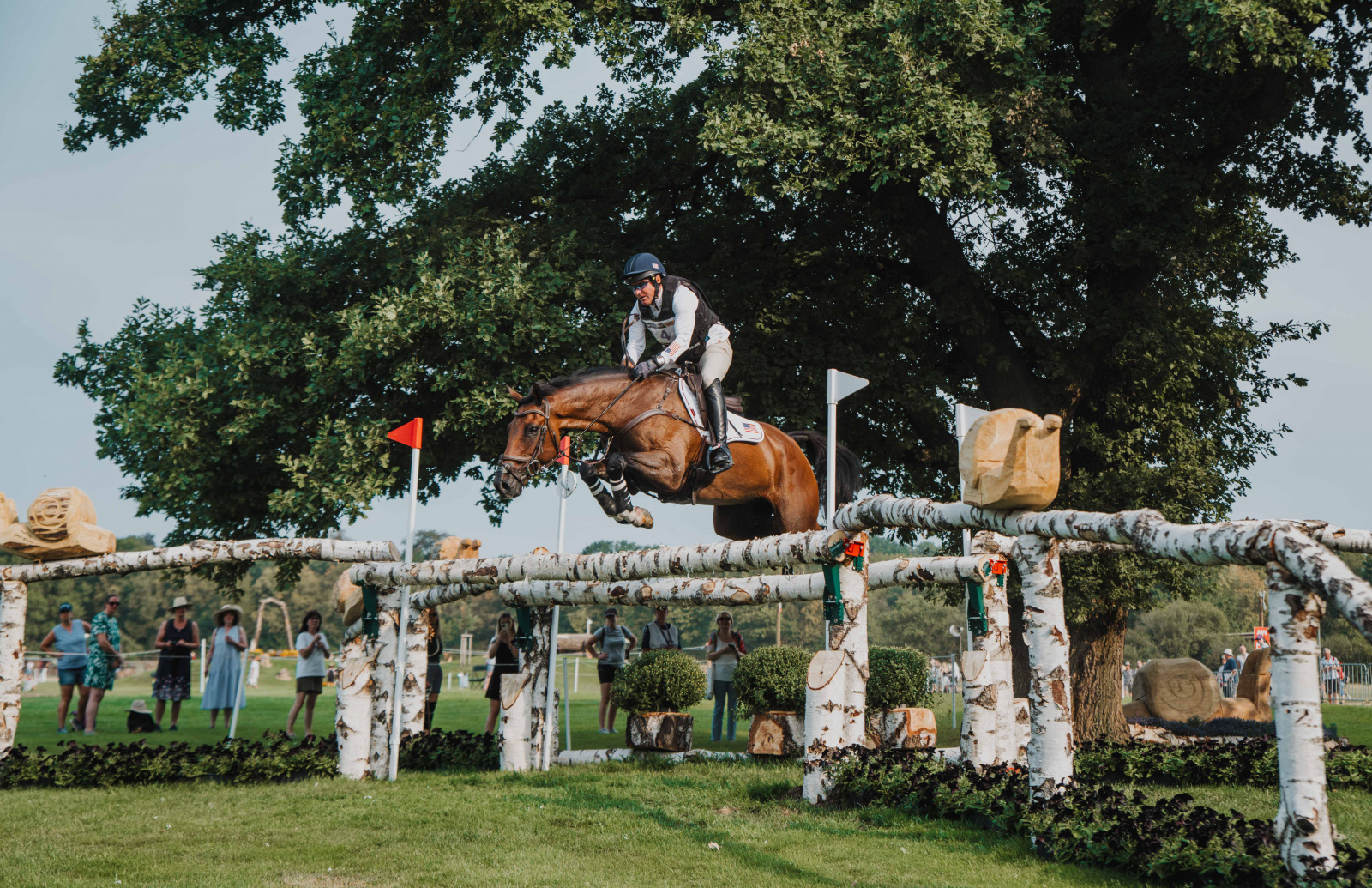
Phillip Dutton and Denim. Photo by Tilly Berendt.
The pressure was on for the USA to elevate their position after starting in sixth after dressage. After some team members delivered dressage scores that weren’t as strong as they hoped, the focus shifted to cross country, where the possibility to make up some ground was strong.
Confident that the weekend would not be a dressage competition, the US riders took the bit in their teeth for the challenge ahead. Phillip Dutton was tapped as the pathfinder, being one of the most experienced on the team. He was, however, on the most inexperienced horse on the team, having never done a five-star. To add, Denim (owned by Annie Jones, Ann Lapides, Caroline Moran and Neill Sites), isn’t the most naturally quick-footed horse in the world. He’d jumped around here at Aachen’s CCIO4*-S last year with a small amount of time, but this four-and-a-half-to-five-star level challenge would be one of the most intense tracks he’s seen to date. Phillip knew he’d need to ride smart to put a clear in the bank for his team.
“He doesn’t have a good high top speed, so I was just trying to keep it as even as I could all the way around,” he said. “The main priority was for me to get a clear round and put that in the bank, and then hopefully everybody can build on it from there. I was trying to help him out as much as I can. There was making up for his inexperience, but he’s a gutsy little horse and a beautiful jumper. And it doesn’t matter where he jumps from; those knees come up around his ears, and so looking back on it, it was fun. It’s not fun out there. But thinking about it now, it’s really rewarding.”
Phillip added 12.4 time penalties, keeping near his EquiRatings average of 13.5 with this horse, to go onto a two-phase score of 45.0 and individual 33rd place. The clear round set the tone for the US riders, who next sent out Paris Olympian Caroline Pamukcu with Mollie Hoff and Sherrie Martin’s HSH Blake. But despite a solid round for the first two-thirds, everything changed at fence 17, the Longines Challenge.
It was a mixed bag of whether riders chose to jump left or right off of this drop; going right put them onto the direct route, going left gave them two alternate options. Caroline went long here, but ran out of power at the CD element and was jarred out of the saddle when Blake hung a leg and had to scramble to right himself on the landing side. It was a gutting result for Caroline, who’d come into this week on fire form.
This upped the pressure and put the US into an Olympic-like situation, in which only three team members remained with no drop score. Boyd Martin and Cooley Nutcracker as well as Will Coleman and Diabolo needed clear rounds to stay in contention.
They delivered.
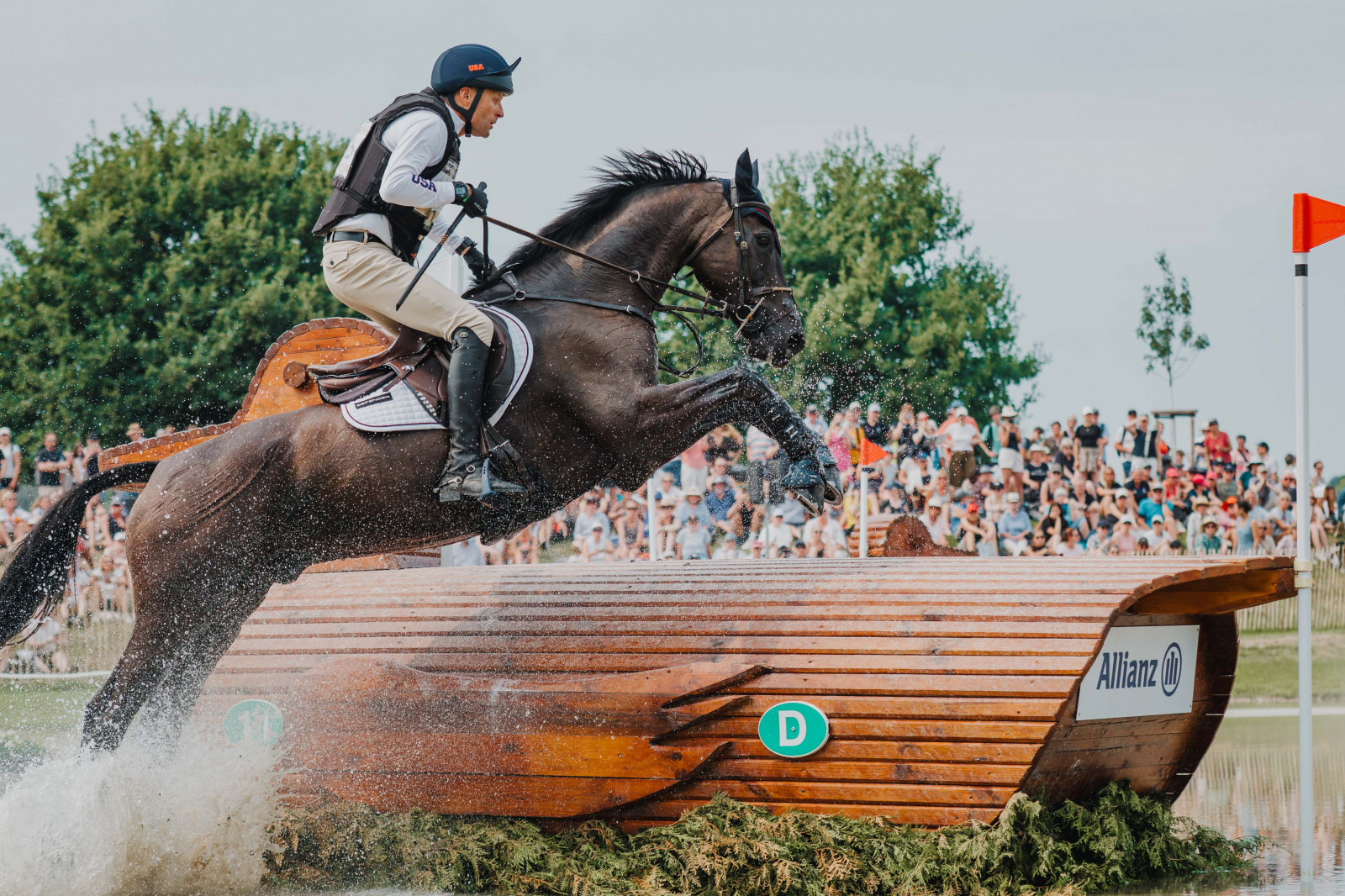
Boyd Martin and Cooley Nutcracker. Photo by Tilly Berendt.
In team competition, strategy is key. While every team operates a little differently, it remains constant that if a team member has an issue, plans and marching orders change accordingly. For Boyd, who was third in the rotation, this meant an adjustment of one plan in particular.
“I was actually all set to go the harder way [at the Longines Challenge bank], but with Caroline crashing before I started, we had a meeting, and they said it’s safer to go the long way, just because we need to go home clear,” Boyd said. “And you got to listen to coaches and very respectful of their decision. But I’d been visualizing the right side, and talking it through with Peter. It’s a little bit slower, but in the end of the day, I feel like we needed a clear around so Will could give it a good crack.”
When riding for themselves, the goal can change — you can chase the time, assume your own risks. But the team comes first in this format, and while Boyd could have gotten home a few seconds quicker had he gone straight at the bank, he also knew “Bali” wasn’t the easiest to turn left (which this question necessitated), and a more serious issue — one that would have effectively ended the US bid for the podium — could have been avoided here.
We wrote earlier about Will’s banner day with Diabolo, coming home clear inside the time to become the highest-placed US rider in the field. Just before him, it was the turn of individual rider Tamie Smith and Molly Duda’s Lillet 3. Tamie and Lillet could well have been on this team in the first place, but there was a bit of a question mark in terms of the mare’s experience.
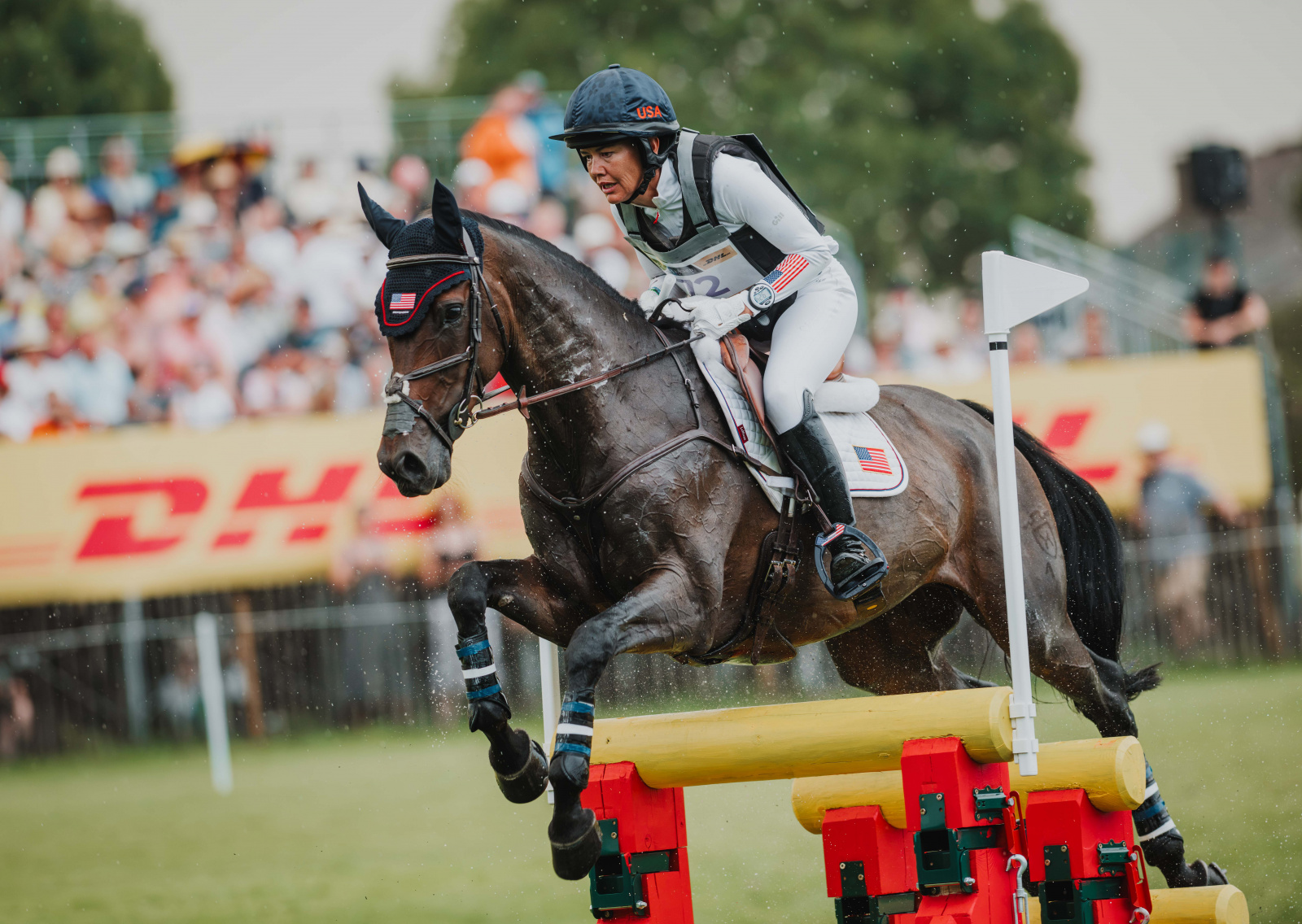
Tamie Smith and Lillet 3. Photo by Tilly Berendt.
She answered that question in emphatic fashion today.
“It was fast and furious and I found out a lot about her – it felt incredible,” Tamie said. “It was the unknown. I rode her like she was a seasoned horse and she acted like one.”
Tamie noted that she opted for a couple of alternates out of care for her horse, and understanding where she was in her career at just 10 years old. “Once I got through the first water, she was just like ‘I got it,’” she said. “I took the long way at the bank and the option at the end just because we don’t know what she knows and I didn’t want to risk anything, but even still a fast round and she fought all the way to the end. What a horse.”
Tamie now sits on a score of 35.0 and is in 18th individually with potentially to move up significantly with a horse who’s a strong show jumper.
For Canada, Jessie Phoenix enjoyed the ride of her life aboard the 18-year-old Fluorescent Adolescent (owned by Sharon Hall and Makayla Rydzik) — a “gangbusters” round, as she puts it. “She just fought so hard all the way around, had a beautiful easy gallop and just made it feel effortless. I really thought she was well-suited to this course. She’s so good on twisty terrain, when you don’t have a lot of strides to pick up the distances and see the flags, Lacey is the one you want to be on. She’s so quick-thinking and she really fights to get between the flags.”
With 12 time added, Jessie goes onto a two-phase score of 47.1 and will be in 36th overnight.
Now, we’ve just got one final hurrah between our field of 65 remaining competitors and the medals. First up will be the final horse inspection, set to take place at 9.30 a.m. local time (8.30 a.m. BST/3.30 a.m. EST) tomorrow morning, followed by showjumping from 1.00 p.m. (12.00 p.m. BST/7.00 a.m. EST). The final group will jump from 3.30 p.m. (2.30 p.m. BST/9.30 a.m. EST). We’ll be back with all the stories you need to know, so keep it locked on EN and as always, Go Eventing!
A huge thank you to Kentucky Performance Products, who are supporting this week’s coverage. You can learn more about Kentucky Performance Products’ science-backed nutritional solutions here.
FEI Eventing World Championships for Seniors (Aachen, Germany): [Website] [Tickets] [Definite Entries by Country] [Timing & Team Scores] [Live Scoring] [Live Stream] [Official App – Apple] [Official App – Android] [EN’s Ultimate Guide] [EN’s Nations Form Guide] [EN’s Coverage] [Support Our Sponsor: Kentucky Performance Products]